
On Expansion
Expansion, as much as any other issue, has exposed the gaping chasm of disconnect between the powers that be in college basketball and the customers they should be responsive to
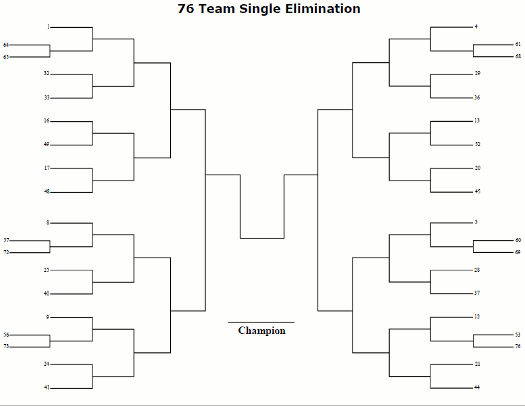
This is what a 76-team bracket would look like.
Like any of the 20-or-so folks who read this blog’s occasional ramblings, I am a certified college basketball sicko. From pre-season exhibitions in October through the tapering off of portal season in late May, I live, breathe, eat and sleep this sport. To quote Jon Rothstein: “we sleep in May.” I want nothing but the best for this sport. I want this sport to continue to grow and be great. I also believe the NCAAT is the coolest sporting event in the world. The collegiate passion, the Cinderellas, the heartbreak and jubilation of tournament where one bad or good night can change the course of a program, or at least turn a disappointing season into something great and memorable. It’s also the rare sporting event where accomplishments short of a championship deserve to be, and are, celebrated.
That is also why I believe expansion is a terrible idea. If it ain’t broke, do not fix it. There is absolutely no need to water down the bracket any further with 4 more play-in games among middling to down-right awful high major teams.
Let’s start with one of the coolest things about the NCAAT: literally all 365 teams (less those that are ineligible) could win March Madness. All they need to do is string together somewhere from 8-12 wins in starting in early March. Of course all chances are not created equal, but that’s the case with any sport. The Wizards and Celtics both could win the NBA title any given year, but we all know which team is infinitely more likely to accomplish that feat. However, the NCAAT is theoretically more amenable to upstarts, given the small sample size of meaningful games at the end of the year render every team capable until they lose a post-season game in March or early April. The Wizards would need to, you know, actually be good, as opposed to say, 2024 N.C. State, who finished the season 17-14, and 9-11 in a shitty ACC, lost its final 4 regular season games—7 out of its last 9—before rattling off 5 straight wins in the ACC Tournament to win a bid, and another 4 in the NCAA Tournament to reach a Final Four, their First since Jim Valvano led them to a national championship in 1983. On March 1, not a single person in America had N.C. State penciled into a Final Four. Hell, after they won the ACC Tournament not a single sane person had them in the Final Four. This is March.
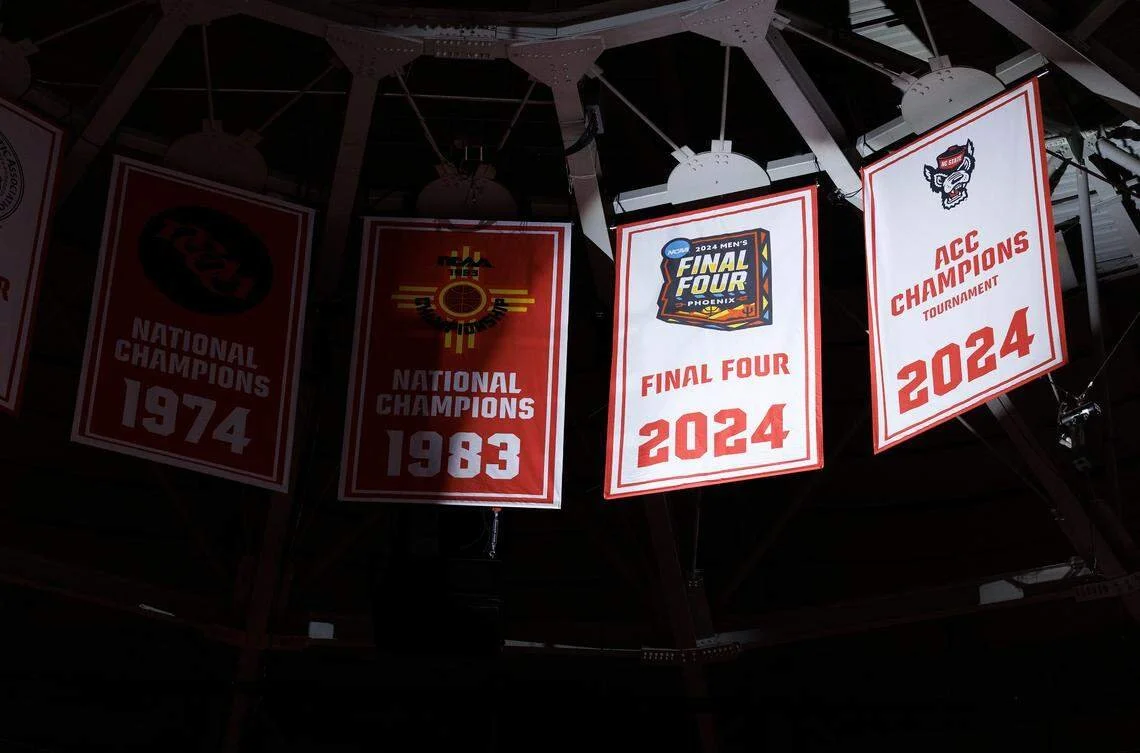
You too can get a banner if you get hot at the right time!
For all of that, they got to hang two banners—the ACC Championship and a Final Four appearance. They earned it. Had N.C. State lost the ACC Tournament Final, they wouldn’t have been deserved a bid, their coach almost certainly would’ve been fired (he got fired after missing the tournament the very next season). However, in an expanded tournament, a middling team like N.C. State hypothetically losing that ACC final, would make the field. You might be saying “well yeah, isn’t N.C. State an example of why we should be OK with adding middling high major teams to an expanded tournament?” OF COURSE NOT. What made the N.C. State run great is that they EARNED it by going undefeated for 9-straight games. They played 9-straight do or die games and won every. last. one. If N.C. State was safely in the NCAA Tournament anyway, the ACC Tournament Final and maybe even the ACC Semifinal would’ve had infinitely less juice. The Final Four run wouldn’t have felt as impressive if it was the back-end of an 8-1 streak, as opposed to a 9-0 streak. The fact that N.C. State had to face the pressure of 5 do or die games before even setting foot on the floor for an NCAA Tournament game is what made it special. Giving them a participation trophy for finishing below .500 in a bad high major league would not have carried the same weight.
Let’s also look at this year. By just about any measure, this has been one of the best college basketball seasons in recent memory. It has been incredibly entertaining, but more than that, the efficiency metrics demonstrate that these programs are playing basketball at a very high level. If Duke finishes the season with its current adjusted net efficiency rating at KenPom, a whopping +40.62, it would be the highest mark in the metric’s history, topping last season’s Duke squad, which posted a record +39.29 to end the season. Prior to that, you need to go alllllll the way back to 2000-01 Duke to find the next highest mark in KenPom history, +37.32, a team that, in a fitting parallel, featured future NBA player Carlos Boozer, father of current Duke stars Cam and Cayden Boozer, the former likely to be a top-3 pick in the NBA draft. That Duke team also featured 4 other NBA players: Shane Battier (AP POY), Jay Williams (AP POY the next season), Mike Dunleavy, Jr. and Chris Duhon. That Duke team romped to a final, and yet this year there are three teams who currently sport a KenPom adjusted net efficiency rating higher than 2000-01 Duke: Duke itself (+40.62), Michigan (+39.35) and Arizona (+37.34). Fourth-ranked Florida is +35.5, a figure you could argue might be higher if the Gators hadn’t started the year so slow. Indeed, over at Torvik, where you can filter by date, Florida has posted an adjusted net efficiency rating of +38.5 since January 5. So needless to say, this is one of the highest levels of basketball we’ve seen played in the recent history of college basketball.
On top of that, the freshman class has proven to be the deepest and most outstanding class we may have ever seen. The following freshman are currently projected first round picks per The Athletic’s Sam Vecenie:
AJ Dybantsa (BYU)
Darryn Peterson (Kansas)
Cam Boozer (Duke)
Caleb Wilson (UNC)
Kingston Flemings (Houston)
Keaton Wagler (Illinois)
Darius Acuff, Jr. (Arkansas)
Mikel Brown, Jr. (Louisville)
Nate Ament (Tennessee)
Brayden Burries (Arizona)
Koa Peat (Arizona)
Hannes Steinbach (Washington)
Braylon Mullins (UConn)
Chris Cenac, Jr. (Houston)
Amari Allen (Alabama)
Tounde Yessoufou (Baylor
And that doesn’t even include a whole bunch of star freshmen that have been integral to their programs: Allen Graves (Santa Clara), Meleek Thomas (Arkansas), Dame Sarr (Duke), Alijah Arenas (USC), Malachi Moreno (Kentucky), Neo Avdalas (Va. Tech), Killyan Toure (Iowa St.), Ebuka Okorie (Stanford), David Mirkovic (Illinois) and more who didn’t crack the Vecenie’s draft board.
All of which is to say, college basketball is in as great a position as it has ever been. Why waste that cultural capital on tournament expansion that does nothing to add to the experience of fans. Here’s the 16 teams that would be next in-line for bids per the most recent Franketology, if the Tournament expanded to 76 teams:
Auburn (45) - 16-15, just no. They’ll be, at best, 2 games over .500 if they don’t win the conference tournament. Just no.
Va. Tech (46) - 19-12, Efficiency Metrics Average of 58.33; 2-10 Q1
SMU (48) - 19-12, not an awful resume, which is why they’re my first team out. If I had my druthers, I probably slot them over Miami (OH)
Stanford (49) - 20-11, but a whopping 3 Q3 losses, 64.33 efficiency metrics average
Cal (50) - 20-10, just 2-3 in Q2, also has a Q3 loss, 70.67 efficiency metrics average
Oklahoma St. (51) - 18-13, yikes. 0-6 in Q1A, 2-10 in Q1, 76.33 efficiency metrics average
New Mexico (52) - 21-9, 0-2 in Q1A, 2-6 in Q1, 2 Q3 losses
Boise St. (53) - 19-10, Q3 loss, efficiency metrics average of 58.33
USC (54) - 17-13, yikes, 1-8 in Q1A, 2-9 in Q1, Q3 loss
SDSU (55) - 19-10, 0-3 Q1A, 2-7 Q1, Q3 loss
McNeese (56) - 24-5, no Q1 wins, Q4 loss, but somehow the least objectionable resume on this list if you like mid-major ball.
Oklahoma (57) - 17-14, yikes, 1-5 in Q1A, 5-5 Q2
Seton Hall (58) - 0-4 Q1A, 1-5 Q1, 2 Q3 losses
Arizona St. (59) - 1-8 Q1A, 4-11 Q1, 68.33 efficiency metrics average, Q4 loss
Belmont (62) - 0-0 in Q1, 4 Q3 losses, efficiency metrics average of 79.33
Cincinnati (63) - 2-6 Q1A, 3-11 Q1, Q4 loss
EIGHT, yes EIGHT of those teams would make an expanded March Madness bracket. Just think about it. Look at those resumes. Think about how mediocre those teams have been, despite this being one of the best, most efficient college basketball season on record.
Why are we expanded to include such mediocre teams? Is anyone really clamoring for a Tuesday Night play-in games from Reno featuring Auburn vs. Stanford, Va. Tech vs. Oklahoma St., SMU vs. Cincinnati and Cal v. New Mexico? How does that add to the tournament in any meaningful way beyond more revenue flowing to the power conferences and their teams that stand to be the beneficiaries of an expanded field. I can categorically say, in my humble opinion, none of these teams really deserve an at-large bid to the NCAA Tournament. Miami (OH) is my last team in right now, and I’m not even convinced they belong.
The point is capitalism and greed reign supreme. The NCAA is beholden to the power conferences, and basketball is a microcosm and reflection of our larger capitalist society: the rich demanding to get richer, and using their wealth to leverage that result, while the poor are left holding the bag. Lots of folks these days love to rail against NIL and the transfer portal—god forbid athletes get paid for the value they bring to an institution or have freedom of movement like the coaches they play for—but the real problem with greed in this sport is the commissioners of the power conferences and the NCAA suits that enable them.
So I am firmly anti-expansion. There’s no need for it when every team has an equal opportunity at the start of the season to make the NCAA Tournament: qualify for your conference tournament (where applicable) by beating your conference peers enough, and then beat your conference peers in the conference tournament. When every team has an equal shot already, why do we need expansion? The conference tournaments are de facto parts of the NCAA Tournament itself. The umbrella term March Madness, at least colloquially, is frequently used for the madness surrounding conference tournament games. Between that, and mediocrity that would be included in an expanded field, it simply does not make any sense unless all you care about is maximizing revenue, and that’s the sad part.
However, I am not an unreasonable man. If expansion is an absolute must, I say we should guarantee an automatic bid to any regular season conference champion that arrives on Selection Sunday without the conference auto bid, and with a WAB ranking of 100 or better. To see how such a scenario would play out, let’s go back to last season, since we really need a full slate of conference tournaments to evaluate.
Teams that would have received an auto-bid last year, with WAB in parentheses:
George Mason (A10)(56) - Shared the regular season title. Lost in the conference tournament. Went 25-8 on the season.
Chattanooga (SoCon)(88) - Won the regular season title by 2 full games. Had won 12 straight before falling to Furman by just 3-points in overtime in the conference tournament semifinals. They went on to win the NIT.
Central Conn. St. (NEC)(100) - Won their league by a full 2 games. Had a great non-conference slate that saw them almost win at Providence and upset the other SJU and UMass. They had won 16 straight before falling in the conference tournament final to 16-18 (8-8) St. Francis.
Teams that would not have received an auto-bid despite winning regular season title due to WAB being too high: Northern Colorado (Big Sky)(104), Arkansas St. (Sun Belt)(108), North Alabama (ASun)(119), Towson (CAA)(124), South Alabama (Sun Belt)(130), Southern (SWAC)(141), James Madison (Sun Belt)(146), Quinnipiac (MAAC)(181).
So that’s it. 3 more teams. If I had more time, I’d use the NET (since WAB didn’t yet exist) and analyze prior seasons, but if you adopted this proposal and expanded to 76, you still get 5 more bids for middling high-majors, but you also get 3 more high majors. Or you could expand it to125 in which cause 7 of 8 expanded bids would have gone to mid-majors. One point worth mentioning, there was a four-way tie for the Sun Belt regular season title last year. In such cases, I would propose just the top WAB team gets the regular season champion auto bid. Using that rule, and expanding to the top-150 WAB teams leads you to all-8 expanded bids going to mid-majors: George Mason, Chattanooga, CCSU, No. Colorado, Arkansas St., North Alabama, Towson, and Southern.
I could see one downside being “well that negates the importance and the drama of conference tournament games. And sure, it does to an extent. But just yesterday we watched Central Arkansas (134 WAB as of this AM) and Queens (NC) (146) face off for the ASun title. Queens (NC) needed the auto bid. Central Arkansas would too if the cut-off was 100, or even 125, as they wouldn’t qualify as a highly-rated conference tournament champion. On the flip side, High Point (70), had insurance from a loss versus Winthrop, and it is well-deserved given their 26-4 regular season. And as for the third possibility, Boston University’s improbably buzzer beater eliminated Navy (84) from the semifinals amidst one of the best seasons in Navy history. Navy deserves to be in the field, it is so tough to win at an academy in the transfer portal era. They had a monster year, and it was all for an NIT bid now. Do you hate the troops or something?!?
I further don’t think that it would deemphasize conference tournament finals. Everyone wants to hang banners. Everyone wants to win their conference. For all of these programs, that’s the one championship they have a real shot at winning. That alone is motivation to compete, even when assured of a bid as a highly rated regular season champion.
So that’s my proposal if we must expand…but I know it won’t happen. Get ready to watch 17-16 Ohio St. face 17-16 Stanford in the First Eight in Reno next March, because whether we like it or not, it’s going to happen.