
Franketology: March 15, 2026
Selection Sunday Final
Here we are. This is March. We’ve seen some Madness already, with the Patriot League favorite Navy going down on an absurd buzzer beater to eventual tournament champion Lehigh. Not to be outdone, The Ivy league final went to overtime on a buzzer beater by TJ Power of Penn, just 3 of his 44 points in the game. He added in 14 boards as well and played 43/45 minutes. The Quakers rode that momentum into overtime to knock off top-seeded Yale. Great first season for erstwhile Iowa coach Fran McCaffery at Penn. The Madness will continue rolling next weekend, the best weekend of the college basketball season.
As for my final bracket, it was pretty calm. A lot has been made over whether the committee truly accounts for conference tournament games (they don’t), but at the end of the day, few made a difference. We also dodged potential bid thieves other than the MAC: Gonzaga in the WCC, Utah St. in the MWC and VCU in the A10 helped bubble teams breath a wee bit easier today.
And what about that MAC. If you believe the efficiency metrics—as I do—the best team won the MAC tournament, Akron. I firmly remain of the belief that Miami (OH) does not belong given the complete dearth of quality wins on their resume. This will be an interesting test case to see how the committee relies on WAB. The WAB of 37 places them squarely in the tournament, and I think the committee will use that to justify their inclusion. If they don’t make it, it’ll be because of the lack of Q1 wins, a NET of 64, and efficiency metric ranks of 93 at BPI, 93 at KenPom and 86 at Torvik. Indeed, the WAB is the ONLY thing indicating potential inclusion.
And what about Auburn? Welp…don’t be shocked if Auburn sneaks in. I do not have them in. But their resume is not that much worse than Texas or SMU, and we all saw what can happen with #brands in the committee room (see: Bubba-gate).
In any event, without further ado, here’s the bracket:
Seed List
Duke
Michigan
Arizona
Florida
Houston
UConn
Purdue
Vanderbilt
Iowa St.
Virginia
Nebraska
Michigan St.
Illinois
Arkansas
Alabama
Kansas
St. John's
Gonzaga
North Carolina
Wisconsin
Texas Tech
Tennessee
Louisville
Miami (FL)
Kentucky
BYU
UCLA
Clemson
Saint Mary's (CA)
Villanova
UCF
Utah St.
TCU
Ohio St.
Georgia
Texas A&M
Last Four Byes
Santa Clara
Missouri
VCU
Saint Louis
Iowa
Last Four In
NC St.
Texas
SMU
Miami (OH)
Additional Auto Bids
McNeese St.
South Fla./Wichita St.
Akron
High Point
California Baptist
UNI
Hofstra
Troy
North Dakota St.
Hawai'i
Tennessee St.
Howard
Kennesaw St.
Penn
Idaho
Furman
LIU
UMBC
Wright St.
Queens (NC)
Siena
Lehigh
Prairie View
First Four Out
Auburn
San Diego St.
Oklahoma
Virginia Tech
Next Four Out
Oklahoma St.
Indiana
California
Arizona St.
Franketology: March 8, 2026
I have given in. I have made the Redhawks an at-large team. I remain strong in my conviction that they are not worthy of an at-large bid, but I have resigned myself to the fact that the committee will not deny them if they lose in the MAC tournament. It’s also a useful exercise in that it creates a bid thief—Akron—who has a better predictive metrics average, and therefore gets the Franketology auto bid.
We also have our first tickets officially punched:
Big South - High Point
MVC - Northern Iowa
OVC - Tennessee State
NEC - LIU
North Dakota and North Dakota St. are squaring off in the Summit League final as I publish this, so if North Dakota wins, this will be outdated by the AM.
The only other point I want to hit on is tournament expansion…oh, that’s all? Yes, that’s all. I’m anti-expansion. The whole world outside of NCAA HQ in Indianapolis is anti-expansion. This year is a perfect example why:
Look at that list. WOOF. None of these teams appear to want to play in the NCAA Tournament. That’s almost literally my entire bubble. Current 10 & 11-seeds: UCF, Missouri, NC St., Texas, Indiana (but not Ohio St. or Santa Clara, 10-seed Iowa lost today, after Matt’s tweet); First Four Out: SMU, Va. Tech, Cal (but not Ok. St.); Next Four Out: Auburn and New Mexico; and deeper bubble teams (for me at least): USC & Seton Hall. This is part of the reason why I’ve relented on Miami (OH), other than my resignation. The gap is just much closer now, and the WAB is too good…
…but back to the point at hand. Expansion. Here are the 16 teams with the highest WABs that are not in my field at the moment:
Auburn (45) - 16-15, just no. They’ll be, at best, 2 games over .500 if they don’t win the conference tournament. Just no.
Va. Tech (46) - 19-12, Efficiency Metrics Average of 58.33; 2-10 Q1
SMU (48) - 19-12, not an awful resume, which is why they’re my first team out. If I had my druthers, I probably slot them over Miami (OH)
Stanford (49) - 20-11, but a whopping 3 Q3 losses, 64.33 efficiency metrics average
Cal (50) - 20-10, just 2-3 in Q2, also has a Q3 loss, 70.67 efficiency metrics average
Oklahoma St. (51) - 18-13, yikes. 0-6 in Q1A, 2-10 in Q1, 76.33 efficiency metrics average
New Mexico (52) - 21-9, 0-2 in Q1A, 2-6 in Q1, 2 Q3 losses
Boise St. (53) - 19-10, Q3 loss, efficiency metrics average of 58.33
USC (54) - 17-13, yikes, 1-8 in Q1A, 2-9 in Q1, Q3 loss
SDSU (55) - 19-10, 0-3 Q1A, 2-7 Q1, Q3 loss
McNeese (56) - 24-5, no Q1 wins, Q4 loss, but somehow the least objectionable resume on this list if you like mid-major ball.
Oklahoma (57) - 17-14, yikes, 1-5 in Q1A, 5-5 Q2
Seton Hall (58) - 0-4 Q1A, 1-5 Q1, 2 Q3 losses
Arizona St. (59) - 1-8 Q1A, 4-11 Q1, 68.33 efficiency metrics average, Q4 loss
Belmont (62) - 0-0 in Q1, 4 Q3 losses, efficiency metrics average of 79.33
Cincinnati (63) - 2-6 Q1A, 3-11 Q1, Q4 loss
Anyone that is telling you they want expansion (so basically just the suits in Indianapolis) is telling you they want EIGHT, count ‘em EIGHT of those teams in the field to get to 76. That is a truly shocking statement, and we need to put the resumes out there so people can see how badly they want to dilute this. If you expand the field, it’s only a matter of time before a 16-15 SEC/B1G team gets into the field.
Fuck expansion.
Anyway, here’s your bracket:
Franketology: March 2, 2026
No time for a write up. THIS IS MARCH!!!!!!
Seed List
Duke
Michigan
Arizona
UConn
Florida
Houston
Michigan St.
Nebraska
Iowa St.
Purdue
Alabama
Texas Tech
Illinois
Kansas
Virginia
Gonzaga
North Carolina
Vanderbilt
Tennessee
Arkansas
St. John's
Wisconsin
Kentucky
BYU
Saint Louis
Louisville
Saint Mary's (CA)
Utah St.
UCF
Miami (FL)
Villanova
NC St.
Clemson
Georgia
Missouri
Iowa
UCLA
Last Four Byes
Texas A&M
Texas
SMU
Ohio St.
Last Four In
New Mexico
VCU
TCU
Santa Clara
Other Auto Bids
South Fla.
Liberty
Belmont
McNeese St.
Yale
Akron
SFA
High Point
Hofstra
UC Irvine
St. Thomas (MN)
Arkansas St.
Navy
Austin Peay
Tennessee St.
Wright St.
Merrimack
ETSU
Howard
Montana St.
LIU
UMBC
Bethune-Cookman
First Four Out
California
Virginia Tech
Southern California
San Diego St.
Next Four Out
Miami (OH)
Auburn
Indiana
Seton Hall
Franketology: February 24, 2026
If you live in a cave and do not get college basketball news, the NCAA Selection Committee released their top-4 seed lines preview on Saturday. Here’s the seed list, with their regions:
Michigan (Midwest)
Duke (East)
Arizona (West)
Iowa St. (South)
UConn (South)
Houston (Midwest)
Illinois (East)
Purdue (West)
Florida (Midwest)
Kansas (East)
Nebraska (South)
Gonzaga (West)
Texas Tech (South)
Michigan St. (West)
Vanderbilt (East)
Virginia (Midwest)
A lot to digest there. I think, as of Saturday, they had this mostly right. Indeed, on Thursday, I had this mostly the same, except I had UConn 8th, Gonzaga over Kansas and Nebraska, and I had already dropped Texas Tech to the 5-seed line anticipating them getting dinged for the Toppin injury, and the rest of my 4-seeds were the same, except I had MSU below Vandy and Virginia. So kudos to me, I guess.
Since that release, a lot has changed. Iowa St. took a bad loss at home to Saunders-less BYU, Duke beat Michigan on a neutral floor. UConn steadied the ship with a win over Villanova, Arizona beat Houston, UVa struggled with Miami (FL) at home, and Vandy narrowly lost at home to Tennessee. This obviously caused some movement, the biggest of which will be that Michigan falls below Duke for the number 1 overall seed. However, this is pure vanity, as it doesn’t affect regional preferences, with Michigan remaining in the midwest region, and Duke remaining in the east. With the bad loss and the UConn win, UConn gets back to the 1-seed line. UConn did most of their work out-of-conference, but they still have the best collection of top-line wins of any team in contention for the last 1-seed, with NET ranks:
UConn: Illinois (N) (4), Florida (N) (7), at Kansas (18)
Iowa St.: at Purdue (6), Houston (8), St. John’s (N) (23)
Houston: Texas Tech (14), at BYU (19), Arkansas (N) (20)
Illinois: at Purdue (6), at Nebraska (11), Tennessee (N) (17)
Purdue: at Nebraska (11), Texas Tech (N) (14), at Alabama (21)
Those wins are keeping UConn a hair above the rest, as they’re 7-2 in Q1, the highest Q1 win percentage of the bunch, have a WAB of 4, and resume metrics average of 4, but they have a predictive metrics average of just 10.33, below the other 4 teams on that list, with ISU and Purdue tied at 7.67. The committee clearly saw fit to reward those quality wins. Should be notable that ISU, who was ahead of UConn in the eyes of the Committee, probably has just the 3rd best set of top-tier wins. Illinois’ trio def gives UConn a run for their money.
All of this is to say, I think you can safely lock the top-3 1-seeds, in whatever order, but there’s everything to play for the teams vying for that last 1-seed.
Many reading this will know, I’m a diehard St. John’s fan, with season tickets at center court, 3 rows behind the announcers. So let’s have a brief discussion about my Johnnies. One of the other things that came out Saturday was that the top-2 5-seeds were Alabama and Arkansas, in that order. Both teams held serve after the announcement, so that means neither is likely to have moved in the eyes of the committee. What that mean, in my humble opinion, is that the final 2 5-seeds comes down to the following 3 teams:

Battle for the last 2 5-seeds
I had SJU on the 5-seed line with Tennessee up to this point. However, with UNC defeating Louisville, without Caleb Wilson gives them the push they need to over take both those teams and slot comfortable into the 3rd 5-seed slot. They have the 2nd best resume metrics in the group. The 2nd most wins against at large teams (based on the current BracketMatrix.com consensus), their top-3 wins stack up nicely against Tennessee, and both blow St. John’s tpo-3 wins out of the water. UNC does not have a loss outside Q1, while Tennessee has a Q2 loss and SJU has a Q3. UNC has more Q1A, more Q1 wins total, and a better Q1A and Q1 win percentage than Tennessee. If there’s one thing that can be taken from the committee’s work on Saturday, it’s that they intend to emphasize quality of wins, and focusing on the high-end wins, over efficiency metrics. It’s admittedly a close call, but given the focus on results, and North Carolina’s lack of bad losses, better Q1A win percentage, better Q1 win percentage, and having 1 more Q1 win than Tennessee, I gave UNC the edge.
After slotting UNC as the 3rd 5-seed, it seems clear to me that St. John’s resume simply isn’t as good as Tennessee. Tennessee has more wins against the field by a factor of 4, they have 5 Q1 wins, all of the Q1A variety versus just 2-1 and 3 total Q1 victories for St. Joh’s, Tennessee’s only loss outside of Q1 is a Q2 loss at Syracuse, which holds up far better than St. John’s Q3 home loss to Providence, and Tennessee is better in every team sheet metrics except KPI.
In short, there simply isn’t a case that St. John’s has a better resume than either of these teams. The only place St. John’s is clearly above either team is in efficiency metrics, and even there, St. John’s only surpasses UNC. This is the unfortunate reality of playing in the Big East this season. Other teams continue to have excellent opportunities to improve their resumes, while the Big East has basically become the East Coast Conference, with 2-3 good teams playing a handful of meaningful games against each other while trying to avoid the land mines. UNC is a prime example—they got a Q1A home home win over a team ranked 14th in NET, with a resume metrics average of 14.67. That’s enough of a boost metrically and in their results to put them over the edge. There’s also the added circumstance that Kansas, by virtue of their win last night over Houston jumped from 18th in NET to 13th in NET, which gave UNC another Q1A win, as Kansas crossed the threshold of 15th for a Q1A home victory. So UNC picked up 2 Q1A wins last night, boosting them up to the 5-line at the expense of St. John’s.
Without further ado, here’s the bracket:
Seed List
Duke
Michigan
Arizona
UConn
Purdue
Iowa St.
Houston
Florida
Illinois
Kansas
Nebraska
Gonzaga
Michigan St.
Virginia
Texas Tech
Vanderbilt
Alabama
Arkansas
North Carolina
Tennessee
St. John's
BYU
Louisville
Saint Louis
NC St.
Wisconsin
Kentucky
Utah St.
Villanova
SMU
Iowa
Auburn
Clemson
Texas A&M
UCF
Miami (FL)
UCLA
Last Four Byes
Georgia
Texas
Indiana
Missouri
Last Four In
Saint Mary's (CA)
TCU
New Mexico
Santa Clara
Other Auto Bids
South Fla.
Belmont
McNeese St.
Yale
Akron
Liberty
High Point
Utah Valley
Hofstra
UC Irvine
North Dakota St.
Austin Peay
ETSU
Navy
Arkansas St.
Merrimack
Wright St.
UT Martin
Marist
Montana St.
UMBC
Howard
Bethune-Cookman
First Four Out
Ohio St.
Cincy
Southern California
VCU
Next Four Out
San Diego St.
Miami (OH)
California
Virginia Tech
Franketology: February 19, 2026
Shortest update of the season, but it feels like we’ve had some Results.™ The night after I posted my February 17 bracketology saw Michigan dominate Purdue in Mackey, SMU get a big home win over Louisville, Iowa eke out a home win over Nebraska, Ohio St. getting a key home win over Wisconsin, N.C. State clipping shorthanded UNC, Georgia beating Kentucky in Rupp, TCU fell to UCF in Orlando, Texas Tech took a bad lass at the hands of ASU, UCLA got murdered in East Lansing leading to another Mick Cronin Meltdown,™ SDSU took a home L versus Grand Canyon, and SLU took a road loss to URI. The next night saw UConn take a huge blow to their 1-seed campaign losing at home to the worst Creighton team in a generation, Seton Hall take a fatal blow at home at the hands of the might ‘mons, Alabama squeak out a home win over Arkansas, Mizzou get a clutch home win over Vandy, Illinois win in the Galen Center, Auburn take a bad loss on the road to Mississippi St., and Arizona beat Saunders-less BYU in Tucson.
How did this affect the field? The most notable is that TCU falls just out of the field. They continue to have one of the most bizarre resumes this side of Cal, and while the committee tends to reward quality, TCU has 2 bad losses, one of which is an absolutely atrocious Q4 loss to Southland also-ran New Orleans. Santa Clara, my last team in, does sport a 1-4 Q1 record, so they have a win, and they’re 6-1 in Q2 versus just 2-1 for TCU, the Q1&2 combined records are 7-5 for Santa Clara versus 6-8 for TCU. Obviously TCU has played more than twice as many Q1 games, but Santa Clara’s metrics out pace TCU’s by a meaningful margin, and that’s enough for me to have them just ahead of the Horned Frogs.
On the other end of the spectrum, UConn losing to Creighton could be the death blow to their 1-seed campaign. I have them all the way down to my last 2-seed. Here’s the blind resumes for my 1 through 3 seed lines:
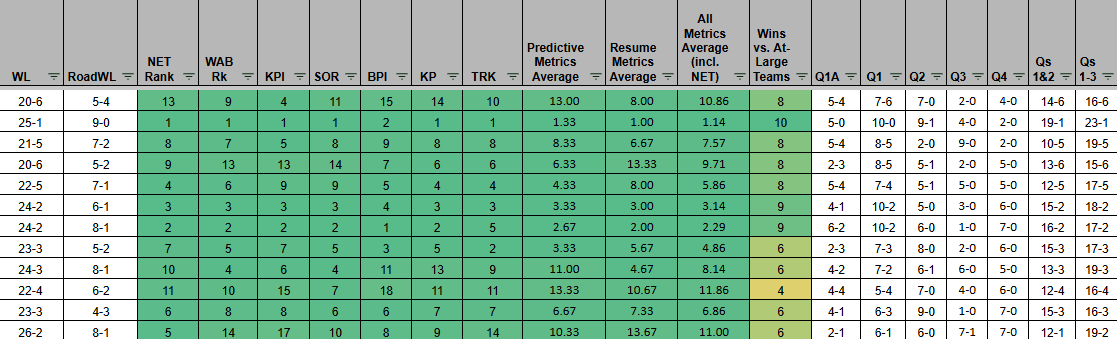
The view from the top.
Obviously, some of these teams are obvious. 25-1 and #1 in every metric except ESPN’s BPI is clearly Michigan. Twos across the metrics except BPI, where they’re 1, that’s Duke. Absolutely wild that ESPN’s metrics is the only one putting an ESPN-conference team at #1, when the rest of the world has the Fox-conference Michigan squad number 1, but that’s another story for another day. Arizona is 3’s across the board except BPI where they’re 4th behind.
So after those 3 obvious 1-seeds, what’s the next best resume? I think you can make a case for the two 23-3 teams. The 22-5 team also has a case, based on the metrics and the Q1 wins. The 24-3 team can also have a case built largely on its resume metrics average, WAB figure, and the 7-2 Q1 record. That said, their predictive metrics are among the worst in this cohort. So for my money, it is one of the two 23-3 teams. Now, it will be tough for me to explain my rationale without exposing these teams, and they are Iowa State and Houston. The 24-3 squad is UConn, and the 22-5 squad is Illinois. I like ISU and Houston the most of this bunch. Given that we just watch ISU beat Houston—albeit barely, and at home—I gave ISU the nod. However, you could easily convince me that it is Houston.
The case for the last 1 seed being UConn is the quality of their top-end wins. They have 4 Q1A wins: BYU (21 NET), Illinois (4) and Florida (9) on “neutral” floors—scare quotes because these were virtual home games in TD Garden, MSG and MSG, respectively—and Kansas (13) in Allen Fieldhouse. However, that’s a 4-pack of wins ISU can mostly match: SJU(24) in a true neutral game, at Mackey Arena versus Purdue (8) and home versus Houston (7). Then, when you factor in ISU having zero losses outside of Q1, I think the picture becomes clearer. Houston’s wins just don’t stack up quite as well, with only 2 Q1A wins: at BYU (21) and versus Arkansas (N)(18). Their 3rd best is home versus Texas Tech (17), which is merely a Q1 game, not Q1A. Illinois also can match UConn’s wins, but UConn obviously has the head-to-head victory: at Purdue (8), at Nebraska (11), Tennessee (N)(19), at Iowa (25).
The call between Illinois and Houston for next on-deck was incredibly difficult. I ultimately gave Houston the slight edge. Their metrics, particularly resume metrics, are a smidge better, and Illinois is the only team of the ISU-Illinois-Houston trio to have a Q2 loss. I could see it go either way though. If Houston drops a Q2 game, it will flip instantly. If Illinois racks up another Q1A win, I could see myself slotting them above Houston. For now, it’s Houston.
As for the rest of the blind resumes, I’ll reference their NETs and then their seed line, and take them in the order they appear in the image:
13 Kansas - 3-seed - Metrics dictate a 3-seed. Lots of quality wins, of course, but that’s not unique amongst this group.
8 Purdue - 2 seed - Once again, the metrics have them here. No losses outside Q1, and 1 more Q1 victory than Kansas.
9 Florida - 3 seed - Out of conference play matters. Florida has been dominant in the SEC, sitting at 11-2, with a 2-game lead on first place. While their win versus Miami (FL) has aged very nicely, they have just 1 huge win, at Vandy, although a home victory over Tennessee is very good too, we have to pick nits here to separate the teams at the top.
11 Nebraska - 3 seed - The ‘huskers were one of the best stories of the first half of the season. A 4-4 record in Q1A games, with wins over MSU and at Illinois carry them this high, but they lack the metrics of the others in this group.
5 Gonzaga - 3 seed - The ‘zags are 26-2, a gaudy record, no doubt. However, they are a bit light in the quality wins department, having the fewest Q1A wins of any team in this group. The metrics are also on par with Nebraska, other than the NET. The ‘zags also have something no one else in this group has, a Q3 loss.
So that’s the top teams. Now let’s talk about the other end of the bracket…or not the bracket, as the case may be.
Miami (OH)…your omission from the field continues! I’ve talked about it before, still 10 points behind Akron in efficiency metrics, and they do not and will not have a Q1 win this season, or even an a Q1 game played. The committee tends to reward quality over just raw win totals. I hope they have the courage to stick to those guns should Miami (OH) ultimately lose in their conference tournament, and don’t blindly follow the WAB into setting a bad precedent. As for me, I am still undecided as to how I think the committee will handle Miami (OH) as an at-large candidate. If I ultimately think they’ll include Miami (OH) with an at-large bid, should they need it, I will eventually adjust this bracket. But given that I’m currently on the fence, I will go with what I would do, which is leave Miami (OH) out if they lose their conference tournament.
For the teams I have that are just outside of the field, I wanted to do a quick run down of what each might need to do. For ease of reference, here are those teams:

The wrong side of the bubble.
Let’s take each of these in order:
TCU - TCU is still struggling to erase the stain of a Q4 loss. They can’t erase that strategy. What they can do is win out, which would get them a marquee road win at Texas Tech. It’s certainly a winnable game now, given Toppin’s injury. While that takes the luster off a bit, it’d still be a third Q1A win, and a huge boost to their metrics. Before they get there though, they have a showdown this Saturday with fellow bubble dweller WVU. It’s in Fort Worth, so I don’t think TCU can survive what would be a Q2 loss, their 4th loss outside Q1. Piling up wins in their other 4 games and a win or 2 in the Big12 tournament should help boost their WAB and the rest of their resume numbers up into at-large range.
Ohio State - Here’s a novel idea…WIN A Q1 GAME! The Buckeyes are an abysmal 0-8 in Q1 games, 6 of those being Q1A. The lack of high end wins is problematic in their own right, but winning just 1 Q1 game down the stretch could boost their WAB and other resume metrics just high enough to be on the right side of the bubble. And you can be excused for thinking a team with 8 blown Q1 opportunities has missed their chance…but that’s not the case here in the stacked B1G. Ohio State will have opportunities at Michigan State, at Iowa, versus Purdue and versus Indiana. They’ll also have to avoid the road landmine in Happy Valley. Sitting at just 17-9, assuming they win the Penn State road game, I’d like to see them go 2-2 in the remaining 4 games, getting at least 1 on the road. If the Buckeyes do that, and avoid a bad loss in the B1G tournament, they won’t even have to sweat on Selection Sunday.
Virginia Tech - Back on February 12th I moved the Hokies from 2nd team out to last team in on the strength of a 10-point road win at Clemson. Since then the Hokies have lost at home to Florida St. (unforgivable) and at Miami (FL) (forgivable), knocking themselves back out of the field. The Hokies are 3-8 in Q1, with a Q1A victory, but they also have a Q3 loss. They have 4 games remaining: They get Wake and BC at home, both being must-wins to avoid a bad loss. They’ll have opportunities to drastically improve the resume at UNC and at UVa. Win both of those and the Hokies will probably be dancing, pending no bad losses in the ACC tournament. Win 1 and the path looks dicier, with a predictive metrics average of 61 and a WAB of 55 currently, 1 more quality win might not be enough to push those metrics onto the right side of the bubble.
SDSU - I consider myself a very casual SDSU fan. My aunt in San Diego is a season ticketholder, and it helps us stay connected. So needless to say, I’m pulling for the Aztecs…but it’s not looking good. SDSU is just 1-5 in Q1, with no Q1A victories. They also hold a Q3 loss at home to Troy. They were my first team out on Tuesday, but a 10-point home loss to GCU knocked them down to fourth team out. If they miss, it’ll end a stellar 6-year run for Brian Dutcher’s crew. They were poised for a 2-seed in 2020, and have made the last 5 tournaments, finishing as the national runner up to UConn in 2023 as a 5-seed. However, all hope is not lost. The Aztecs have 3 Q1 opportunities in their final 5 games: home for Utah St. (22), at fellow bubble dweller New Mexico(42) (possible at-large eliminator), and at Boise St. (65). Avoid the land mines when at Colorado St. and home for UNLV, and go 2-1in the Q1 games, and the Aztecs will see themselves right back in the picture. The MWC manages to find a way to maximize its tournament teams every year, to the point that it feels like they rigged it that way. So I fully expect the MWC to shake out in a way that gets both New Mexico and SDSU in the field. I have no support for this, just my conspiratorial belief that it always works out for the MWC—and of course there’s probably a 75% chance we see a bid thief in this league for a fourth MWC bid. Mark my words.
WVU - The Mountaineers beat UCF in Orlando on Valentine’s day, and things were looking up. I had them as First Four Out on Tuesday. However, last night, they did the unthinkable, dropping a home game to 9-16 Utah. Ick. With their best opportunity for a big win being Saunders-less BYU at home, they would have to win out and make some noise in the Big12 tournament if they want to make the field. The rest of their schedule: at TCU, at Oklahoma St., at Kansas St., and home for UCF. Not much to move the needle there.
VCU - The Rams are riding the nation’s 7th longest winning streak at 10 games. Unfortunately, they have not beaten a single team in the top-80 of KenPom in that stretch. Their metrics are right on the cusp, such that if they can finish out the regular season with four more wins, they can probably get themselves on the right side of the bubble, as long as they avoid disaster in the A10 tournament. That path starts with the toughest game of the stretch at SLU. A win there gives VCU 2 things it desperately needs: a Q1 win and a win over an at-large team. After that, they’ll have to beat Fordham and George Mason at home and Dayton on the road.
Cal - One of the most interesting resumes in my 3 years of doing this. The Golden Bears are a pretty 4-5 in Q1, including a Q1A win, very good relative to the rest of the bubble. However, a peek under the hood reveals that to be less impressive than at first blush. They have a neutral site win over fellow bubble dweller UCLA, that was virtually a home game at the Chase Center in San Francisco. They caught UNC when the Tar Heels came to Berkeley, and got a cross-bay road win against rival Stanford, which is barely clinging to Q1 status. Their best win is a 1-point road victory at Miami (FL). Further cutting against that Q1 record is a bizarre 0-3 in Q2 games, losing at FSU, at Syracuse and at K-State. In their final 5 games they’ll probably need to win out, given that they only have one really good opportunity: a Q2A home game versus tourney-bound SMU. They’ll also have a Q1 road game at 14-12 Wake Forest. In between they need to avoid home land mines to Stanford and Pitt and a road landmine at lowly Georgia Tech. 5-0 probably gets it done, 4-1 probably not—but if the loss is the SMU or Wake Forest games, it’s possible—anything less and they’re certainly screwed.
Miami (OH) - They’ll never convince me, but they can probably convince the tourney by winning out and losing in the MAC title game. I hope for everyone’s sake they just win the damn MAC tourney, so we don’t have to deal with this shit.
Seton Hall - This IS a Big East centric blog (when I find the time lol) so let’s touch on hall, who would be my 9th team out. They were in Next Four Out territory on Tuesday, sitting 18-8, with 3 land mines (v. DePaul, v. Georgetown at Xavier) and 2 marquee matchups (at UConn and vs. St. John’s) left to play. They did the one thing they couldn’t afford to do, and stepped on the land mine losing by 12 at home to the ‘mons. That is likely the nail in the coffin for Seton Hall. To get back into contention at this point, they’d probably need to win out, including at UConn and versus St. John’s. IF they win the UConn game (the bigger prize given it is a road game and Q1A) and lose to St. John’s, it would give them a 2nd Q1 win and a first Q1A win. It would depend how that shakes out in WAB and the rest of their metrics.
Stanford - This is the last team I’ll mention, because it is another interesting resume, to say the least. The Cardinal is 4-4 in Q1, with 2 Q1A wins. However, they’re just 2-3 in Q2 and 4-3 In Q3. Those 3 Q3 losses are serving as an anchor around their necks, because the top lines of this resume are pretty good: wins vs. SLU (N), vs. Louisville, and vs. UNC. They also hold a win at Va. Tech. However, losing to Seattle, UNLV and Notre Dame, all at home, is brutal. That said, I brought them up for a reason. They have ample opportunity to improve this resume, with the following Q1 opportunities down the stretch: at Cal and at NC St., with Q2A opportunities vs. SMU and at Notre Dame. Win them all and they’re in the picture. Even 4-1, depending on the loss could see them almost to the right side of the bubble.
Next Eight (no particular order): Liberty (current auto bid), Belmont (current auto bid), Oklahoma St., Arizona St., Boise St., GCU, Wake Forest, S. Florida
That as a long-ass prelude, so let’s get to the main event:
Seed List
Michigan
Duke
Arizona
Iowa St.
Houston
Illinois
Purdue
UConn
Florida
Gonzaga
Kansas
Nebraska
Vanderbilt
Virginia
Michigan St.
Alabama
Texas Tech
Arkansas
Tennessee
St. John's
Louisville
North Carolina
BYU
Kentucky
Utah St.
Villanova
Saint Louis
Iowa
NC St.
Wisconsin
Clemson
SMU
Miami (FL)
UCF
Texas
Auburn
Indiana
Last Four Byes
Georgia
Missouri
Texas A&M
UCLA
Last Four In
Southern California
Saint Mary's (CA)
New Mexico
Santa Clara
Other Auto Bids
South Fla.
Belmont
McNeese St.
Liberty
Yale
Akron
SFA
Hofstra
High Point
Hawai'i
Austin Peay
St. Thomas (MN)
Navy
Merrimack
Wright St.
ETSU
Arkansas St.
Montana St.
UT Martin
Howard
Bethune-Cookman
Marist
Vermont
First Four Out
TCU
Ohio St.
Virginia Tech
San Diego St.
Next Four Out
West Virginia
VCU
California
Miami (OH)
Fraketology: February 17, 2026
The bubble remains quite difficult to sort out. Consider the following blind resumes:
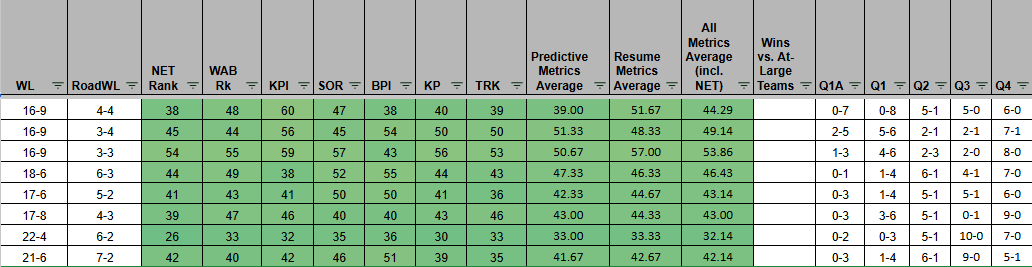
The immediate bubble picture at this moment.
For me, it is quite difficult to discern these teams from one another. And no single criteria can really eliminate or include everyone. At first blush, one might be inclined to start by tossing the two teams that have 0 Q1 wins. A noble criteria, and one I put a decent amount of weight on (see Miami (OH)). However, the team with the 22-4 record, but 0-3 in Q1 has metrics—both resume and predictive—that would make it truly shocking if they were omitted—33 predictives average, 33.33 resume metrics average and 32.14 all metrics, as a NET of 26 pulls those 2 averages up. That’s compared with the 16-9 team with 0 Q1 wins, who is outside the picture from a resume metrics average perspective, and right on the cusp in the all-important WAB. However, their NET and predictives are in-line with a bid. The other distinction is that the 16-9 team has had (and failed) to win a Q1 game in 8 opportunities, the 22-4 team has only had 3 attempts.
The team currently 54th in NET also presents an interesting case. They are a very good, relative to the bubble, 4-6 in Q1. The 2nd most wins and 2nd best win percentage on the bubble. However, the metrics are too far afield to warrant inclusion, particularly the resume metrics average of 57 and the WAB of 55. The predictives are not high enough to save this resume, and so, for my mind, they are out, and actually the 4th team out.
As an example of how narrow the margins can be in these things, the 45th NET team is 5-6 on Q1, including 2-5 in Q1A, the best in both categories among these bubble teams. So comparing them, to the 54th NET team, you would think that this resume is also in trouble, particularly once you factor in the Q3 and Q4 losses this team has suffered. However, the resume metrics—an average of 48.33 and a WAB of 44 profile out meaningfully better than the 57 and 55, respectively, of the 54th NET team. There is also the NET gap of 9 ranks.
There are also a trio of teams that are identically 1-4 in Q1, with 0 Q1A wins, each with 1 loss in Q2, 2 of them with 1 loss in Q3, and one with a Q4 loss. You could once again be forgiven for thinking the fate of these teams would rise and fall together, given how identical their resumes are. Their resume metrics averages are 41.67, 42.33, 47.33, and predictive averages of 42.67, 44.67, 46.33. Their WABs are 40, 43, and 49. To complicate things, the team with the slightly better metrics across the board is also the team with the Q4 loss, as opposed to Q3 losses for the other 2. So the question becomes, is the slight difference in metrics enough to overcome the difference between a Q3 and a Q4 loss? I felt like it is, particularly given the healthy WAB of 40 for the team with the Q4 loss.
The last team has the clear best resume, sporting the 3rd highest NET (39), a WAB within range (47), and an overall metrics average that puts them 3rd among this group. What sets them above those with better metrics is their 3-6 record in Q1, 3rd best among this bubble group (while having better metrics than the teams with the best 2 Q1 records), and lacking the bad losses of the team with the best Q1 record.
Ultimately, here’s how I sorted these resumes:
Line 1 - Ohio St. - 3rd team out - Held back by the poor Q1 record, which is also dragging down their resume metrics average, particularly a KPI rank of 60.
Line 2 - TCU - 2nd to last team in - I am of the belief that their gaudy Q1 record is more than enough to compensate for middling metrics and the 2 bad losses (2 things which are undoubtedly connected)
Line 3 - WVU - 4th team out - the lack of bad losses and the 4-6 Q1 record simply wasn’t enough to overcome the worst metrics of this bubble group.
Line 4 - SDSU - 1st team out - this was where things got tricky, SDSU, New Mexico and Santa Clara all have strikingly similar resumes. Unfortunately for the Aztecs, I had Santa Clara a smidge ahead of SDSU, and that happens to be where this cut line fell.
Line 5 - New Mexico - 2nd team out - I had New Mexico ranked a smidge below SDSU, based on the metrics, the only real separation between their resumes
Line 6 - Georgia - 4th to last team in - the best of this bunch, for the reasons outlined above, basically a combination of their metrics with a decent Q1 record
Line 7 - St. Mary’s - 3rd to last team in - the metrics here are imply too good to ignore. I’m probably overly pessimistic on the Gaels’ seeding here, but I find it difficult to reward a team that has not won a Q1 game.
Line 8 - Santa Clara - last team in - the metrics give them the slight edge over New Mexico and SDSU, despite the Broncos’ Q4 loss.
Without further ado, here’s the bracket:
Seed List
Michigan
Duke
Arizona
Iowa St.
UConn
Houston
Purdue
Illinois
Florida
Nebraska
Gonzaga
Vanderbilt
Virginia
Kansas
Texas Tech
Michigan St.
Louisville
Alabama
Arkansas
St. John's
Tennessee
North Carolina
Saint Louis
BYU
Kentucky
Wisconsin
Clemson
Utah St.
Villanova
NC St.
Miami (FL)
Auburn
Iowa
Indiana
SMU
Texas
UCF
Last Four Byes
Texas A&M
Southern California
Missouri
UCLA
Last Four In
Georgia
Saint Mary's (CA)
TCU
Santa Clara
Other Auto Bids
South Fla.
McNeese St.
Belmont
Liberty
Yale
Akron
High Point
Hofstra
Hawai'i
Utah Valley
Troy
Austin Peay
St. Thomas (MN)
Navy
Merrimack
ETSU
UT Martin
Wright St.
Montana St.
Howard
LIU
Bethune-Cookman
Vermont
First Four Out
San Diego St.
New Mexico
Ohio St.
West Virginia
Next Four Out
Virginia Tech
Seton Hall
California
Miami (OH)
Franketology: February 12, 2026
Lukas Harkins and Rocco Miller, two great bracketologists, and Eamonn Brennan, who is at least one of, if not the earliest purveyor of a “Bubble Watch” column (certainly the first I was ever aware of way back in his ESPN days) started a new podcast under Trilly Donovan’s Basket Under Review umbrella, called Bracket Under Review. Very clever. Their first episode discussed some hard-to-evaluate resumes. And frankly, I think there are a lot of those this year. So here’s a few that I find difficult to evaluate at this time:
Miami (OH)
I have made my thoughts on Miami (OH) well-known. They were the subject of conversation in this space a few editions ago, and I’ve tweeted about them as well. I have put my foot down (for now), and have them out of my bracket. They’re not even the auto bid. My rule, since I started doing this in 2023-24, is that predictive metrics are what I use to select auto bids. Logically, that’s the only thing that makes sense to me. Standings are irrelevant, since the regular season champ does not get the auto bid. We’re trying to predict who will win the conference tournament, and for my money, that is best done by predictive metrics. Indeed, sportsbooks will even base their conference tournament odds on the predictive metrics. In the MAC, Akron has the highest predictive metrics average, at 71.00 to Miami (OH)’s 83.33.
Well what about an at-large? I have noted before that last season, in the first season of the NCAA’s version of WAB, everyone in the top-40 that needed it got an at-large bid. 8/10 teams ranked 41-50 got a bid, and no one 50 or worse in WAB got a bid. The two exceptions were 19-13 West Virginia, infamously dinged for the Tucker DeVries injury, despite playing well without him, and 19-13 Indiana. Both teams had NET rankings north of 50. The only team to get in with a NET worse than 50 last year was Drake, NET of 56 on Selection Sunday. However, they sported a 28-3 record, and unlike Miami (OH), had a 2-0 Q1 record and a 4-0 Q2 record. Miami (OH) currently has a NET of 50, and a WAB of 33. So WAB indicates clear inclusion, while the NET tends to indicate “wrong side of the bubble.”
While I understand the committee’s seeming emphasis on resume metrics, I refuse to believe that the committee will reward a team that has not even attempted, let alone won, a Q1 game, and is a mere 2-0 in Q2. I do not care how high the WAB gets, I do not care how high the win total gets. If they do not win the MAC tournament, I would not advocate for their inclusion in the NCAAT as an at-large bid. They simply don’t deserve it.
Stanford
This is one that I find very very interesting. Stanford is 16-9, and 3-3 on the road—a point I think is important. They’re 2-3 in Q1A, 4-3 in Q1 overall. However, they have 3 Q3 losses, all at home, versus UNLV, Notre Dame and Seattle. The reason why I think the road record is relevant here, is one could dismiss Stanford’s quality wins based on them being them the difficult West Coast trip in the ACC. However, they have a quality road win at fellow bubble-dweller Virginia Tech. Their resume metrics are close, and it’s conceivable they get into the top-50 of WAB, currently at 59, with Q1 opportunities at Wake Forest, Cal and NC St., plus a home Q2A versus SMU, currently 34th in NET. Definitely a resume worth monitoring.
TCU and Cal
Can’t talk about Stanford and not these 2, both of whom are closer to the bubble than Stanford, and also have 4 Q1 wins. TCU has a WAB of 52, and a NET of 47, so they’re quite close. But they also suffer from some bad losses, most notably an opening-night Q4 home loss to Southland also-ran, New Orleans, currently 222 in NET, as well as a Q3 loss at home to Notre Dame in OT. On the other side of the ledger, they have neutral wins over Florida and Wisconsin, home and away wins over Baylor, and most recently, a home win over Iowa St. that saw them post their best defensive raw and 2nd best adjusted efficiency metric of the season. The remaining schedule is favorable for TCU to rack-up some wins, at Oklahoma St. and Kansas St., and home for WVU, Arizona St. and Cincinnati, while still offering two quality win opportunities at UCF and Lubbock.
Cal is trending in the opposite direction, coming off a home thrashing at the hands of Clemson and a double overtime loss at Syracuse. They’re also oddly enough 0-3 in Q2. They lack the high-end signature wins of TCU, but hold a neutral win over UCLA, a home win over UNC, and road wins over Stanford and Miami (FL). They lack any further opportunities for an elite win, but will get Stanford and SMU in Berkeley. Otherwise, they’ll have the oppportunity to rack up wins at BC, Georgia Tech, Wake Forest and home for Pitt.
Baylor
For my Johnnies brethren, this one resonates. Baylor has been hovering around the top-50 of NET necessary for that neural win to count as Q1 for the Johnnies. Currently 46 in NET, Baylor is just 63 in WAB, and has a win-loss record of 12-11. The WAB is just 63. However, they will have a ton of opportunities to improve that WAB, playing Louisville on a neutral floor, Arizona at home, and UCF and Houston on the road, interspersed with home games against Arizona St. and Utah and a trip to Manhattan to face Kansas St. In other words, the opportunities are there to get onto this bubble. They’re 3-9 in Q1. If they can go 3-1 in the quality opportunities, and avoid the bad loss down the stretch, they could finish 19-12, and likely have the metrics and quality wins for inclusion. Going 18-13 overall—implying just 2-2 in these quality opportunities—and they’ll have to do some work in the Big12 tournament and likely still be sweating on Selection Sunday. So the stakes are high for the Bears down the stretch.
St. Mary’s
Given my hardline stance on Miami (OH), a discussion of St. Mary’s is also necessary. The Gaels are 21-4, 28th in NET and 37 in WAB. However, the Gaels are 0-3 in Q1, but 4-1 in Q2. Of course, what separates the Gaels from Miami (OH) is that their predictive metrics averages are 32.67, well within the range of inclusion. However, given the lack of Q1 wins, St. Mary’s drops roughly 1 to 2-seed lines from what their metrics would imply, which is an 8/9 seed, down to a 10-seed for me. I wanted to drop them a bit farther, but the teams behind them have too many resume flaws for me to drop the Gaels further. USC, e.g. has significantly weaker predictive metrics, UCLA significantly weaker resume metrics, conference mate Santa Clara has a Q4 loss and just a single Q1 win.
St. Louis
How do you seed the Billikens? The predictive average implies a 6 seed, as does the resume metrics average. But they’ve only got 2 Q1 wins. However, we’ve seen the committee the last few years reward mid-majors with low Q1 win totals if the winning percentage was good, and it doesn’t get any better than St. Louis’ Q1 win percentage of 100%, 2-0. Therefore, I’ve slotted the Billikens right where their metrics indicate they should be: the 6-seed line.
Seton Hall
The Hall started the season in questionable fashion, struggling with Wagner in their 2nd game out, and not passing the eye test in their first 5 buy games. Then they went to Maui and beat NC St. by 5, and narrowly lost to USC. Big East play has not been kind to the Pirates, as they’ve dropped both opportunities against Villanova, lost home games to UConn and Butler, and lost at St. John’s, DePaul, and Creighton. That said, all hope is not lost for the Pirates. They have a huge game (for them) this Sunday at Butler, which remains a Q1 opportunity at this time, and they’re coming off their best offensive performance of the season against providence. If they want to make the NCAAT, winning out would almost certainly do the trick. Dropping 1 of the big opportunities vs St. John’s or UConn and it gets a bit sweatier, but I’d still like their chances. Like Baylor, a lot to play for down the stretch. If the Providence game is a sign of the offense turning a corner, and not just a flash in the pan, they’ll certainly have a shot at pulling off an upset with their defense as good as it is—18th in the Country per KenPom versus an offense ranked 172nd.
Without further ado, here’s the bracket:
Seed List
Arizona
Michigan
Duke
UConn
Houston
Iowa St.
Illinois
Florida
Purdue
Kansas
Nebraska
Michigan St.
Texas Tech
Vanderbilt
Gonzaga
Louisville
Virginia
Arkansas
Alabama
St. John's
Tennessee
Saint Louis
North Carolina
Clemson
BYU
Kentucky
Utah St.
NC St.
Villanova
Auburn
Iowa
Wisconsin
Indiana
SMU
Texas A&M
Georgia
UCF
Last 4 Byes
Miami (FL)
Saint Mary's (CA)
Texas
Southern California
Last 4 In
UCLA
Santa Clara
Missouri
Virginia Tech
Other Auto Bids
Tulsa
Belmont
Liberty
McNeese St.
Yale
Utah Valley
Hofstra
Akron
High Point
Hawai'i
Troy
St. Thomas (MN)
Austin Peay
ETSU
Portland St.
Wright St.
Navy
UT Martin
Marist
LIU
Howard
Bethune-Cookman
Vermont
First 4 Out
Ohio St.
San Diego St.
New Mexico
TCU
Next 4 Out
Oklahoma St.
California
Seton Hall
Miami (OH)
Franketology: February 9, 2026
No write-up today. Enjoy!
SEED LIST
Arizona
Michigan
Duke
UConn
Houston
Iowa St.
Illinois
Michigan St.
Nebraska
Purdue
Florida
Kansas
Gonzaga
Vanderbilt
Virginia
Texas Tech
Alabama
Tennessee
North Carolina
St. John's
Saint Louis
Louisville
Clemson
Arkansas
BYU
Utah St.
Kentucky
Iowa
Auburn
Villanova
Texas A&M
UCF
Georgia
NC St.
SMU
UCLA
Wisconsin
Last Four Byes
Indiana
Texas
Southern California
Miami (FL)
Last Four In
Santa Clara
San Diego St.
Saint Mary's (CA)
Missouri
Auto Bids
Tulsa
Belmont
McNeese St.
Liberty
Akron
Yale
High Point
Troy
Hofstra
Utah Valley
Hawai'i
St. Thomas (MN)
Austin Peay
Portland St.
ETSU
Wright St.
Navy
Marist
LIU
UT Martin
Bethune-Cookman
Vermont
Howard
First Four Out
Oklahoma St.
Virginia Tech
California
Miami (OH)
Next Four Out
New Mexico
Ohio St.
Stanford
Baylor
Franketology: February 2, 2026
The calendar has turned to February. We’re about 6 weeks from Selection Sunday. The picture for me still seems very muddy around the bubble. You have several teams that completely lack a Q1 win, remain unblemished outside Q1&2 (but for Santa Clara’s Q4 loss) but have metrics indicating potential inclusion:
St. Mary’s (CA): 32 NET/37 WAB/37.67 Predictives Avg./36.33 Resume Avg.
Miami (OH): 53 NET/33 WAB/87.33 Predictives Avg./36.67 Resume Avg. (auto bid team)
Oklahoma St.: 67 NET/45 WAB/66.00 Predictives Avg./44.67 Resume Avg.
George Mason: 65 NET/43 WAB/83.67 Predictives Avg./39.33 Resume Avg.
Santa Clara: 43 NET/47 WAB/43.33 Predictives Avg./48.00 Resume Avg.
Now compare those to these teams near the bubble metrically, but which have multiple Q1 wins:
Texas: 39 NET/51 WAB/35.33 Predictives Avg./56.00 Resume Avg.; 3-4 in Q1; 0 Q3&4 losses
Cal: 51 NET/41 WAB/60.00 Predictives Avg./42.37 Resume Avg.; 3-4 in Q1; 0 Q3&4 losses
Va. Tech: 55 NET/48 WAB/64.67Predictives Avg./44.33 Resume Avg.; 2-5 in Q1; 1 Q3 loss
Mizzou: 70 NET/49 WAB/56.33 Predictives Avg./51.67 Resume Avg., 3-4 in Q1, no Q3&4 losses
Stanford: 78 NET/60 WAB/84.00 Predictives Avg./55.67 Resume Avg.; 4-3 in Q1, 3 Q3 losses
Baylor: 56 NET/67 WAB/51.00 Predictives Avg./65.67 Resume Avg.; 3-6 in Q1, no Q3&4 losses
TCU: 54 NET/63 WAB/55.00 Predictives Avg./64.67 Resume Avg.; 3-6 Q1, 1 Q3 loss; 1 Q4 loss
Washington: 47 NET/61 WAB/45.00 Predictives Avg./61.67 Resume Avg.; 2-7 Q1; no Q3&4 losses
And of course we haven’t even touched upon the bubble teams with just 1 Q1 victory:
Wisconsin: 41 NET/35 WAB/36.33 Predictives Avg./37.67 Resume Avg.
New Mexico: 42 NET/40 WAB/46.00 Predictives Avg./39.67 Resume Avg.; 1-3 Q1, 1 Q3 loss
Ohio St: 40 NET/52 WAB/39.67 Predictives Avg./52.67 Resume Avg.; 1-6 Q1
Seton Hall: 49 NET/53 WAB/52.00 Predictives Avg./50.67 Resume Avg.; 1-3 Q1
SDSU: 45 NET/50 WAB/46.33 Predictives Avg./51.00 Resume Avg.; 1-4 Q1, 1 Q3 loss
How does one separate these teams? It’s tough because there’s no definitive answer. Different emphases will result in different results. For my money, I tried to focus on the WAB and quality wins, with predictive metrics third, as I believe that most accurately reflects what the committee has done in recent years. But there’s certainly no right way or wrong way to order these teams.
I ordered them as such, with seed line:
10 Texas
11 Cal
11 Wisconsin
11 Va. Tech
11 St. Mary’s (CA)
11 Mizzou
11 Miami (OH)
FFO New Mexico
FFO Ohio St.
FFO Seton Hall
FFO SDSU
NFO Ok. St.
NFO George Mason
NFO Santa Clara
NFO Stanford
Others: Baylor, WVU, TCU, Washington
Pick it apart all you want, I’m far from a pro at this. Here’s the rest of it:
SEED LIST
Arizona
Michigan
Duke
UConn
Illinois
Iowa St.
Houston
Gonzaga
Nebraska
Purdue
Vanderbilt
Michigan St.
Florida
Kansas
Texas Tech
BYU
Tennessee
Virginia
North Carolina
Alabama
Arkansas
Louisville
St. John's
Saint Louis
Clemson
Auburn
Texas A&M
Kentucky
NC St.
Iowa
UCF
Utah St.
Villanova
SMU
Indiana
Georgia
Miami (FL)
Last 4 Byes
UCLA
Southern California
Texas
California
Last 4 In
Wisconsin
Virginia Tech
Saint Mary's (CA)
Missouri
Other Auto Bids
Miami (OH)
Tulsa
Belmont
McNeese St.
Liberty
Yale
High Point
Utah Valley
UNCW
Hawai'i
Troy
North Dakota St.
Austin Peay
Wright St.
ETSU
UT Martin
Marist
Navy
Montana St.
Merrimack
Bethune-Cookman
Howard
Vermont
First Four Out
New Mexico
Ohio St.
Seton Hall
San Diego St.
Next Four Out
Oklahoma St.
George Mason
Santa Clara
Stanford
Franketology: January 24, 2026
The apocalyptic blizzard has rolled into town for this Newarker, so I’m bored. That means it’s time for another Franketology. I also think a fair amount has changed with every team playing at least 1 game, and many 2 since the morning of the 20th when I published my last Franketology.
Also, I’m human, I make mistakes, and I think not including Cal after their win over North Carolina was probably a mistake. They should have been next 4 out, at worst with a WAB of 40 on January 20, when I last did one of these. Between my mistake and Cal backing up the UNC victory with a road win over bay area rival and fellow bubble team Stanford, is enough for them to go from nowhere to be found, to last 4 in. Texas kind’ve a hard luck loser her, falling out of the bracket after losing at Kentucky—no shame there—and backing that up with a quality home win over Georgia. Their WAB still sits on the wrong side of 50. The rest of the resume metrics average to just 57.67. and they have 3 losses outside Q1 to Ohio St.’s 1, with OSU’s loss falling in Q2, while Texas still holds a Q3 loss. You could probably convince me either way between OSU and Texas, but based on what we saw with WAB last season, I will let the WAB break the deadlock, and put OSU in over Texas.
It’s also time we talk about Miami (OH). Yes, the debate for my last team is between OSU and Texas, despite having Miami (OH) being seeded as my last at-large team. Why? Because I don’t believe the committee will leave out a team with a 32 WAB, but I also don’t believe a team with predictive metrics of 83 and 0 Q1 games, let alone a Q1 win will be seeded any higher than last team in. Frankly, if it weren’t for what we saw with WAB last season, I would probably have Texas over Miami (OH). If I were on the committee, Miami (OH) would be nowhere near the bubble.
Travis Steele recently said “ People are going to say, ‘well who did they play?’ You still got to win. We’re 19-0 — haven’t lost any games. We’ve won on the road. We’ve won neutral. We’ve won home.” And that is true. Any team going undefeated is impressive. The issue I take is with his next statement “[d]on’t penalize us for people [who] aren’t willing to play us.” Sorry, that simply isn’t a complaint you get to make when you scheduled the 362nd ranked out-of-conference strength of schedule out of 365, a slate that included 3 non-D1 opponents. It does not have to be like that.
While I am sympathetic to the difficulty of scheduling when you’re a respected mid-major, as Miami (OH) is under Travis Steele, there are plenty of mid-major squads that scheduled much better than Miami (OH). The west coast mid-majors (WCC, MWC, Big West) are perfect examples. These programs schedule lots of games amongst themselves to help their SOS, rather than what Miami (OH) did, which is schedule 3 non-D1 opponents and only 2 D1 opponents ranked in the top-200 of KenPom (139 Wright St. and a to-be-played early-February date with 168 Marshall). It’s not like they got surprised or got bad luck, no one expected much from Old Dominion (KP 238), Air Force (346), D1 transitional program Mercyhurst (295), Arkansas-Pine Bluff (309), UNC Greensboro (305), Maine (345), UNC-Asheville (218), or the 3rd best directional Kentucky school—Eastern Kentucky (261).
Compare that abysmal Miami (OH) schedule to that of fellow bubble hopeful Santa Clara, who arguably has a tougher time scheduling as they’re in a significantly better conference than the MAC. They scheduled only 1 non-D1 opponent—their opener versus Cal Poly Humboldt—and scheduled games vs. McNeese (66), at Xavier (85), vs. Nevada (67), vs. Idaho St. (214), an MTE where they faced St. Louis (24) and Minnesota (84), at New Mexico (46), vs. Arizona St. (N)(83), and vs. N. Texas (N) (144). That should be a lesson in how to schedule for a mid-major. It’s also not an anomaly. McNeese only gets 9 games due to a 22-game Southland schedule, and they still scheduled very strong in the other 7-games: at Santa Clara (43), an MTE where they drew George Washington (70) and Murray St. (91), Mid. Tennessee (148), Rhode Island (109) and Michigan (2). They faced just 1 D1 non-conference opponent currently outside the top 150, Louisiana (331). UC San Diego had 2 non-D1 opponents, and not a single non-conference opponent outside the top-200 (200 San Diego was the worst—a local rivalry). Oakland, Middle Tennessee and McNeese, all highly regarded mid-majors managed top-15 OOC schedules (2, 8, 15).
And look, there are a lot of complexities in scheduling, any discussion of the same will necessarily flatten the difficulty. But let’s look at preseason mid-majors ranked higher than Miami (OH), who was 127th preseason, with their current OOC SOS rank, per KenPom:
30 SDSU - 50
42 Utah St. - 129
60 VCU - 232
65 St. Louis - 319
79 Colo. St. - 279
80 GCU - 307
81 George Washington - 249
84 San Fran - 175
88 N. Texas - 261
91 George Mason - 335
92 Nevada - 117
94 Akron - 258
97 New Mexico - 144
98 UAB - 289
99 (lol) Loyola Chicago - 317
100 Liberty - 146
101 McNeese - 15
102 Yale - 140
103 High Point - 357
104 S. Florida - 78
105 Santa Clara - 85
106 Bradley - 150
107 UNLV - 164
108 Belmont - 296
109 the other SJU - 299
110 Duquesne - 318
111 Utah Valley - 116
112 Rhode Island - 297
113 Hawaii - 364
114 Tulane - 300
115 UC Irvine - 172
116 Northern Iowa - 208
117 Seattle - 311
118 Chattanooga - 274
119 Richmond - 347
120 UNCW - 360
121 Illinois St. - 250
122 St. Bonnies - 288
123 Drake - 286
124 Troy - 97
125 Kent St. - 273
126 UCSB - 223
The fact that Miami (OH)’s out-of-conference schedule is as bad as it was is entirely self-inflicted.
And don’t get it twisted, I am ALL for more mid-major representation in the NCAAT. If I had my druthers, when they expand the tournament—another discussion for another day, I’m opposed, but it will happen eventually—they should guarantee a bid for every regular season and conference champion. Eliminate the bid thieves, get more mid-major representation. A win-win. But Miami (OH) ain’t it. Mid majors I would personally give Miami (OH)’s spot to tomorrow: SDSU, Seton Hall, Santa Clara, VCU, George Mason, Boise St., GCU, Nevada, and S. Florida.
So Miami (OH) has no one to blame but themselves if they don’t get an at-large. /End Rant
Without further ado, here’s the Franketology:
SEED LIST
Arizona
Michigan
Duke
UConn
Nebraska
Illinois
Michigan St.
Iowa St.
Purdue
Gonzaga
Houston
Vanderbilt
BYU
Texas Tech
Virginia
Kansas
Arkansas
Tennessee
Alabama
Florida
Louisville
Saint Louis
North Carolina
St. John's
Auburn
Villanova
Georgia
Kentucky
SMU
Clemson
Iowa
Utah St.
Texas A&M
UCF
Wisconsin
NC St.
UCLA
Last Four Byes
Miami (FL)
Saint Mary's (CA)
New Mexico
Virginia Tech
Last Four In
California
Missouri
Ohio St.
Miami (OH)
Auto Bids
Tulsa
Belmont
Yale
McNeese St.
Liberty
Akron
Troy
Utah Valley
High Point
Hawai'i
North Dakota St.
Hofstra
ETSU
Lipscomb
Wright St.
Montana St.
Marist
Navy
UT Martin
Merrimack
Vermont
Bethune-Cookman
Howard
First Four Out
Texas
San Diego St.
Southern California
Stanford
Next Four Out
Indiana
TCU
Seton Hall
Butler
Bold = Auto Bid
Franketology: January 20, 2026
Some interesting stuff happening with Franketology in this edition. We now have four two-bid leagues. WCC is of course expected, with Gonzaga and St. Mary’s. For several years now it’s also been a given that the MWC would get at least two teams. That is not guaranteed this year by any stretch. At the moment, Franketology has SDSU narrowly squeaking in by virtue of its recent home win over New Mexico. Depending on how things play out the rest of MWC, the February 28th return game at The Pit could determine whether SDSU or New Mexico gets an at-large bid. Utah St. gets the auto bid, and has a clear at-large case at this point in time, and is very likely to get an at-large should they need it.
Joining the ranks of multi-bid leagues are the A10. St. Louis gets the auto bid, but is certainly more than worthy of an at-large as well. George Mason joins SLU as the last team in the field, by virtue of being undefeated in quads 2-4, which has their resume metrics average at 37.33 and WAB at 38. Mason’s only loss was at Virginia Tech, certainly forgivable. That said, with an 0-1 record in Q1, and only 2 remaining Q1 opportunities, the Patriots have little margin for error in A10 play, and will likely need to pick up 1 of those 2 Q1 opportunities (assuming VCU remains a Q1 road opportunity, which they should, currently sitting at 55th in NET versus a 75th cut-off for Q1 status for road games). That said, if Mason finishes with a top-40 WAB, it’ll be very unlikely we see them left out, hell if any team finishes top-40 in WAB, it’s highly unlikely they will be out in the cold come Selection Sunday.
Finally, the last multi-bid league in this edition…the MAC?! Yes, the MAC. MACtion is having a very good year relative to their expectations and history. Part of the reason this is a two-bid league right now is the way that I do my auto bids, which was covered in a prior edition of Franketology. Using predictive metrics average, Akron is actually the best team in the conference, 71.66 to 87.66. However, Miami (OH) currently as a WAB of 29, and there’s almost a 0% chance the committee leaves out a team with a WAB of 29. Miami (OH) has already beaten Akron in Miami, and due to unbalanced scheduling, we will be deprived of a return game. The nice part about the numbers working out this way is that it functions as a bit of a bid thief, which is more reflective of what is likely to happen come March (a bid thief or 2) than a traditional mid-January bracketology, which generally has at-large-caliber teams in one-at-large-bid leagues getting the auto bid.
I also like to compare what I’m doing to BracketMatrix. I don’t change anything, I check it when I’m done, see if I have any blind spots or issues to incorporate for the next Franketology. One area where I have a decent-sized disagreement with the Matrix is as regards Stanford. Matrix has them as the last bye, narrowly avoiding the First Four as an 11-seed. I have them as my 2nd-highest 9 seed. Why? They’re 4-2 in Q1, with a Q1A neutral victory over SLU and a Q1 road victory at Virginia Tech. They’ve beaten Louisville and UNC at home. The metrics are not wild about the Cardinal, other than KPI, their highest metric at 25. NET has them just 68th and WAB has them 40th. Their highest efficiency metric is Torvik, 69th. They’re being docked style points for bad losses at home to Notre Dame, Seattle and UNLV. Notre Dame is barely a Q3 loss, with the Irish clocking in at 78. Seattle and UNLV are not great losses, but they’re respectable mid-majors. Counterbalancing those 3 losses is the 4 Q1 Ws, including a Q1A W. They’re the lowest seeded team with at least 3 Q1 wins, and that feels right to me.
Without further ado, here’s the Franketology:
TRUE SEED LIST
Arizona
Michigan
Duke
UConn
Nebraska
Purdue
Houston
Gonzaga
Vanderbilt
Illinois
Iowa St.
Michigan St.
BYU
Virginia
Florida
Alabama
Kansas
Texas Tech
Clemson
Arkansas
St. John's
Louisville
Saint Louis
Villanova
Tennessee
North Carolina
Kentucky
Iowa
Utah St.
UCF
SMU
Miami (FL)
Georgia
Stanford
Auburn
Texas A&M
Wisconsin
Saint Mary's (CA)
Southern California
Seton Hall
Texas
San Diego St.
Missouri
Miami (OH)
George Mason
Tulsa
McNeese St.
Belmont
Yale
Liberty
Akron
High Point
Hofstra
Utah Valley
Troy
Hawai'i
Wright St.
St. Thomas (MN)
ETSU
Montana St.
Marist
Lipscomb
Colgate
UT Martin
Merrimack
Vermont
Southern U.
Howard
First Four Out
Baylor
Butler
UCLA
NC St.
Next Four Out
Indiana
Ohio St.
New Mexico
LSU
Franketology: January 9, 2026
I don’t have anything to write here. So let’s talk briefly about AutoBids. I have a few that might raise eye brows, and are definitely out of step with the BracketMatrix consensus. I base my autobid recipients on the predictive metrics average. Why? Because you’re trying to predict who is going to win a conference tournament on a neutral floor. The team with the best predictive metrics will have the highest odds of winning the conference tournament. So this gives me teams like Akron, who has significantly better metrics than undefeated MAC-mate Miami (OH). It gives me Hawaii—yes Hawaii!—instead of Big West darling UC San Diego. It gives me Wright State over Oakland in the Horizon and Arkansas St. over Troy in the Fun Belt and Norfolk St. over Howard in MEAC. Of course there’s still plenty of consensus, with the following auto-bids in 1-bid leagues aligning between Franketology and BracketMatrix.com: Tulsa (AAC), Vermont (AE), Lipscomb (ASun), Northern Colorado (Big Sky), High Point (Big South), Hofstra (CAA), Liberty (CUSA), Yale (Ivy), Quinnipiac (MAAC), Belmont (MVC), LIU (NEC), UT-Martin (OVC), Colgate (Patriot), SoCon (ETSU), McNeese (Southland), St. Thomas (MN) (Summit), Grambling (SWAC), and Utah Valley (WAC).
So that’s auto bids. On to the reason you’re al here:
SEED LIST
Michigan
Arizona
Iowa St.
Vanderbilt
UConn
Purdue
Gonzaga
Duke
Nebraska
Houston
BYU
Michigan St.
Illinois
Kansas
Virginia
Texas Tech
Alabama
Louisville
Arkansas
Utah St.
Tennessee
North Carolina
Florida
Clemson
SMU
Villanova
Saint Mary's (CA)
Indiana
Iowa
UCF
Seton Hall
St. John's
Saint Louis
Miami (FL)
Auburn
Oklahoma St.
Southern California
Texas A&M
Kentucky
Georgia
Stanford
Missouri
Ohio St.
California
Virginia Tech
Tulsa
McNeese St.
Belmont
Yale
Akron
Hofstra
Liberty
Utah Valley
High Point
Hawai'i
Arkansas St.
St. Thomas (MN)
Quinnipiac
Northern Colo.
ETSU
Wright St.
Lipscomb
UT Martin
Colgate
LIU
Vermont
Grambling
Norfolk St.
First Four Out
TCU
NC St.
UCLA
Creighton
Next Four Out
New Mexico
Baylor
Wisconsin
Butler
Franketology: New Year’s Day Edition, January 1, 2026
The theme, at least to this point in the season: parity has returned to CBB! Among the top leagues, here’s the bid totals and percentage of teams from the Power 5 leagues:
ACC: 9 (50%)
B1G: 8 (44%)
Big12: 9 (56%)
Big East: 5 (45%)
SEC: 9 (56%)
Essentially, every team getting half of their teams into the NCAAT per the latest Franketology. By way of refresher, here’s what last season’s bracket looked like:
ACC: 4 (22%)
B1G: 8 (44%)
Big12: 7 (44%)
Big East: 5 (45%)
SEC: 14 (88%)
So really pretty similar except the ACC is back, and the SEC is not nearly as dominant as it was last season, although it still rates out as the best league per KenPom. The other interesting note is that for all the consternation about the Big East, they’d still get 5 teams in if the NCAAT started today, and has another team (Creighton) knocking on the door—First Four Out per Franketology.
Now, some will certainly disagree with my assessment. For instance, I have Virginia Tech in over Ohio State, against the Bracket Matrix consensus. The Bracket Matrix consensus has Oklahoma appearing in almost 1/3rd of the brackets, so there is no shortage of supporters for another ACC team either. However, by and large you’re talking about a 1 team difference either way for most Bracketologists.
The issue for the SEC this year is that the bottom of that conference is not nearly as strong as it was last year:
Texas is 9-4 with one decent win, on Maui versus N.C. State. Their 2nd best win is KenPom 244 Southern, followed by 301 Le Moyne. They’ve lost to KP 9 Duke, KP 79 Arizona St., KP 26 Virginia, and KP 6 UConn. So one questionable loss, also on Maui, versus a single good win, and an overall SOS that is quite weak (320th per KenPom). Their resume metrics average is 91.33 (64 WAB); their efficiency metrics average is 45.33 and their NET is 58. Nothing there profiles as a surefire NCAAT team.
Texas A&M is 10-3, and played a similarly weak schedule, ranked 346th by KenPom. Their best win is versus KP 93 Pittsburgh. They sport losses to at KP 60 Oklahoma St., home vs. KP 45 UCF, and vs. KP 40 SMU on a neutral floor. Resume metrics average of 80.67 (73 WAB), 42.23 efficiency metrics average, and a NET of 67. Once again, not profiling like an NCAAT team.
Oklahoma is the closest team on the outside of the NCAAT right now, their best wins are at KP 61 Wake Forest and versus KP 60 Oklahoma State on a neutral floor. They also lost to Arizona State on a neutral floor, KP 23 Nebraska on a neutral floor and at KP 5 Gonzaga. Their overall SOS is 332 per KenPom.
Mizzou is 10-3 against the 352nd ranked schedule per KenPom, with their best win coming at home versus KP 99 Minnesota. They’ve lost at KP 59 Notre Dame, versus KP 17 Kansas and KP 8 Illinois on neutral floors. They have an efficiency metrics average of 57.67 and a resume metrics average of 78.67 (WAB 60). Their NET is 94.
The Mississippi schools, Ole Miss and Mississippi State each sport 8-5 records with resume metrics averages and WABs north of 100. The teams share a best win against KP 73 Memphis, both at home. Both would have to go on absolutely insane tears in SEC play if they are to make the NCAAT, and neither has shown they’re capable of such a run.
South Carolina is 9-4 against the 360th ranked schedule in America per KenPom. Their best win—no joke—is an 83-79 overtime win against Southern Miss, ranked 192nd per KenPom. Resume metrics average, WAB and NET are all north of 100. Of all the team’s on this list, you’d have to say they’re the one team that has almost no shot at making the tournament despite the abundance of opportunities for quality wins in the SEC, with 13 Q1 opportunities on the schedule per my count.
Zooming out to the bigger picture, what we see is that last season the SEC went 30-4 against the ACC and this season they went 17-15. So 2 less games, but significantly worse record for the SEC. They picked up 2 games against the Big East (7-4 this season, 5-4 last), but were also worse against the B1G (6-10 versus 10-9) and the Big12 (6-15 versus 14-2). More parity. And that is now reflected in the bracketology.
The other important point about those intraconference records, it makes it difficult for the SEC to get many more teams in than where they’re at right now. Around this time last year Franketology had 13 SEC teams in, and they finished with 14 in Franketology and the actual bracket. I had 3 Big East teams, they finished with 4 in the actual bracket. I had 4 ACC teams and they finished with 4 in the actual bracket. I had 8 for the Big12, they finished with 8 in Franketology and 7 in the actual bracket. In other words, it’s hard for conferences to pick up a significant amount of bids once out-of-conference play is over.
So after that lengthy spiel, here is your first Franketology of 2026:
SEED LIST
Michigan
Arizona
UConn
Iowa St.
Gonzaga
Purdue
Duke
Vanderbilt
BYU
Michigan St.
Alabama
Nebraska
Houston
Illinois
Kansas
North Carolina
Louisville
Texas Tech
Saint Mary's (CA)
Tennessee
Villanova
Kentucky
St. John's
Florida
Utah St.
Iowa
Arkansas
Southern California
SMU
Auburn
Clemson
Virginia
Georgia
NC St.
Seton Hall
LSU
UCF
Saint Louis
UCLA
Miami (FL)
Baylor
Oklahoma St.
Virginia Tech
Boise St.
Butler
Tulsa
McNeese St.
Akron
Yale
Illinois St.
Utah Valley
UC San Diego
Liberty
Hofstra
High Point
Quinnipiac
Troy
Northern Colo.
St. Thomas (MN)
Lipscomb
ETSU
Wright St.
UT Martin
Colgate
LIU
Vermont
Southern U.
Norfolk St.
(FFO) Ohio St.
(FFO) Creighton
(FFO) Oklahoma
(FFO) California
(NFO) VCU
(NFO) TCU
(NFO) Kansas St.
(NFO) New Mexico
Franketology: First Edition, December 23, 2025
Well, out-of-conference play has mostly wrapped. So now is as good a time as any to kick of Franketology 2025-26. Plus I desperately need a distraction from my incredibly disappointing Johnnies.
However, with such an early bracketology, it’s definitely not easy to determine seeding or even select which teams belong on the right and wrong side of the bubble. The sample sizes are small. There’s wide divergence between predictives and resume metrics in many cases. There are teams with strong metrics that lack Q1 wins, etc. Some of it is a matter of philosophy. Do you apply the principles the committee will apply in March as if the field were being seeded today? If so, then you need to focus on resume metrics, which is what the committee has leaned heavily on the last 2 years. Doing that would yield some very odd results. For instance, that could conceivably lead to a world where Ok. St., Va. Tech, Tulsa and Miami (OH) make the NCAAT and St. John’s, Baylor, Indiana and NC State, do not, if you focus on WAB. Not teams that are overly deserving in any event, but certainly more deserving than Tulsa and Miami (OH), the latter of which doesn’t have a single win in the first 2 quadrants. If you focus on resume metrics averages, you could conceivably end up with Ok. St., Tulsa, Va. Tech, New Mexico and Colorado in the field, at the expense of Kentucky, Bosie St., NC St. and Indiana. Resume Metrics averages also bring St. Louis and Yale into at-large territory.
Therefore, some middle ground is necessary. There needs to be a focus on the resume metrics, no doubt, but this early in the process there needs to be more emphasis on the predictive metrics than will likely be warranted come March. So that’s what I did, attempted to weight the resume metrics against the predictive metrics, taking into account actual quadrant results so a team like Miami (OH) or Tulsa, who have merely stacked low-level wins, are not at-large caliber.
To highlight the difficult, particularly around the bubble, let’s do some blind comparisons for my last 8 in the field, plus the first 8 out of the field, in no particular order, identities below the bracket:
NET 32, WAB 63, 0-2 Q1, 1-1 Q2, 8-0 Q3&4, Predictives Avg. 23.33, Resume Avg. 57.67, Best Win: NET 52, home
NET 49, WAB 58, 0-1 Q1, 2-1 Q2, 6-0 Q3&4, Predictives Avg. 36.00, Resume Avg. 54.67, Best Win: NET 77, home
NET 60, WAB 54, 0-1 Q1, 1-1 Q2, 9-0 Q3&4, Predictives Avg. 80.33, Resume Avg. 45.33, Best Win: NET 36, home
NET 46, WAB 38, 1-2 Q1, 1-1 Q2, 7-0 Q3&4, Predictives Avg. 51.00, Resume Avg. 41.67, Best Win: NET 31, neutral
NET 44, WAB 30, 1-1 Q1, 0-0 Q2, 10-0 Q3&4, Predictives Avg. 63.67, Resume Avg. 34.67, Best Win: NET 40, neutral/semi-home
NET 29, WAB 36, 0-2 Q1, 1-0 Q2, 8-0 Q3&4, Predictives Avg. 33.33, Resume Avg. 37.33, Best Win: NET 75, neutral/semi-away
NET 74, WAB 32, 0-0 Q1, 4-1 Q2, 7-0 Q3&4, Predictives Avg. 65.67, Resume Avg. 27.67, Best Win: NET 64, home
NET 61, WAB 49, 1-2 Q1, 1-1 Q2, 6-0 Q3&4, Predictives Avg. 51.67, Resume Avg. 53.67, Best Win: NET 68, away
NET 59, WAB 43, 0-1 Q1,4-1 Q2, 7-0 Q3&4, Predictives Avg. 73.67, Resume Avg. 36.00, Best Win: NET 99, neutral
NET 37, WAB 24, 0-2 Q1, 4-0 Q2, 6-0 Q3&4, Predictives Avg. 46.33, Resume Avg. 21.67, Best Win: NET 46, home
NET 64, WAB 84, 0-2 Q1, 1-1 Q2, 8-0 Q3&4, Predictives Avg. 41.00, Resume Avg. 85.00, Best Win: NET 119, away
NET 42, WAB 50, 0-1 Q1, 3-1 Q2, 6-0 Q3&4, Predictives Avg. 32.67, Resume Avg. 47.67, Best Win: NET 56, home
NET 35, WAB 42, 0-2 Q1, 1-0 Q2, 10-0 Q3&4, Predictives Avg. 37.00, Resume Avg. 46.67, Best Win: NET 98, away
NET 53, WAB 60, 0-3 Q1, 2-1 Q2, 6-0 Q3&4, Predictives Avg. 46.33, Resume Avg. 68.00, Best Win: NET 59, neutral
NET 48, WAB 33, 2-2 Q1, 1-1 Q2, 4-0 Q3&4, Predictives Avg. 58.00, Resume Avg. 56.00, Best Win: NET 24, neutral
NET 52, WAB 53, 1-2 Q1, 2-1 Q2, 5-1 Q3&4, Predictives Avg. 56.67, Resume Avg. 52.00, Best Win: NET 41, home
Even as I was typing this out, I made an adjustment to my order. But what you see is you have it all here. Strong predictives and mediocre resume average? Number 1. 2 Quad 1 wins, but middling metrics? Nos. 14 & 16. Elite resume metrics, but middling predictives? Nos. 7 and 10. No Quad 1 wins, but strong overall metrics? Nos. 6 and 10.
So there’s something for everyone. A veritable feast of teams with varied resumes. Here’s how I sorted it all out:
So for those that have made it this far, here’s the answer key for the blind resumes above, with the true seed and seed line I gave them:
Indiana - 41, 11-seed, Play-in
Ohio St. - 70, First Four Out
Butler - 39, 10-seed
Colorado - 76, Next Four Out
Cal - 37, 10-seed
Villanova - 43, 11-seed, Play-in
Okla. St. - 69, First Four Out (this is the team I removed from the field while typing out the blind resume exercise)
Oklahoma - 74, Next Four Out
Va. Tech - 72, First Four Out
SMU - 42, 11-Seed, Play-in
Texas A&M - 71, First Four Out
Baylor - 38, 10-seed
Miami - 40, 10-seed
VCU - 73, Next Four Out
Boise St. - 44, 11-seed, Play-in (this is the team I added while typing out the blind resume exercise)
Kansas St. - 75, Next Four Out
I’m sure many will have the same visceral reaction to including Boise State that I had initially. However, it’s not right to deny a team with 2 Quad 1 wins among this group. Had to get over the visceral reaction to knowing they lost to a D2 school, because they’ve done enough since then, at least at this moment in time. Indeed, the next lowest team with 2 Quad 1 wins is Seton Hall, true seed rank 27, a 7-seed. Sending Boise St. to Dayton if the tournament started today feels like sufficient punishment for losing at home to a middling D2 squad.
On the point of Q1 wins, there’s several teams that got in without a Q1 win, and several left out without a Q1 win. A lot of that is due to having “good enough” resume metrics—resume metrics having proven key to inclusion the last 2 years—and having high predictive metrics, indicating Q1 wins are likely coming. Those teams without a Q1 W, but included are:
Iowa - NET 11, WAB 35, Predictives Avg. 23.33, Resume Avg. 33.33
Utah St. - NET 17, WAB 25, Predictives Avg. 28.33, Resume Avg. 25.00 - Got the auto bid in this bracketology, but well within range for an at-large at the moment.
St. Mary’s (CA) - NET 24, WAB 29, Predictives Avg. 33.00, Resume Avg. 29.33
Georgia - NET 20, WAB 44, Predictives Avg. 25.33, Resume Avg. 39.00
Baylor - NET 42, WAB 50, Predictives Avg. 32.67, Resume Avg. 47.67
Miami - NET 35, WAB 42, Predictives Avg. 37.00, Resume Avg. 46.67
Indiana - NET 32, WAB 63, Predictives Avg. 23.33, Resume Avg. 57.67
SMU - NET 37, WAB 24, Predictives Avg. 46.33, Resume Avg. 21.67
Villanova - NET 29, WAB 36, Predictives Avg. 33.33, Resume Avg. 37.33
These teams had an average NET of 27.44, and an average WAB of 38.11. Compare that to the teams listed below with a Q1 win, who were omitted from my current field. I have taken the liberty of eliminating teams with a single upset, and almost no chance of ever making the NCAAT: Bowling Green, Denver, New Orleans, and San Diego, thereby only including plausible NCAAT teams also in plausible multi-bid leagues (Power-5 plus A10, AAC, MWC and WCC in this bracketologist’s humble opinion—not to say all of those leagues are multi-bid, but it’s at least plausible this year):
Grand Canyon - NET 93, WAB 91, Predictives Avg. 83.33, Resume Avg. 91.33, Q3 loss
New Mexico - NET 55, WAB 45, Predictives Avg. 75.33, Resume Avg. 40.00
Notre Dame - NET 82, WAB 76, Predictives Avg. 67.00, Resume Avg. 68.00, Q4 loss
Rhode Island - NET 102, WAB 117, Predictives Avg. 106.67, Resume Avg. 108.33, Q3 loss
Richmond - NET 90, WAB 70, Predictives Avg. 104.00, Resume Avg. 74.00, 2 Q3 losses
South Florida - NET 63, WAB 108, Predictives Avg. 76.33, Resume Avg. 93.00, 1-5 in Q1&2
Stanford - NET 76, WAB 56, Predictives Avg. 77.67, Resume Avg. 49.67, Q3 & Q4 losses
Syracuse - NET 92, WAB 65, Predictives Avg. 73.33, Resume Avg. 82.33, Q3 loss
TCU - NET 66, WAB 66, Predictives Avg. 59.00, Resume Avg. 72.33, Q3 & Q4 losses
Texas - NET 54, WAB 64, Predictives Avg. 43.67, Resume Avg. 91.00, 1-4 Q1-3
Washington - NET 56, WAB 80, Predictives Avg. 54.33, Resume Avg. 67.67
The average NET of this group is 75.36 and the average WAB is 76.18, obviously large differences from the group of included 0-Q1-win teams. Many of these teams also sport bad losses (GCU, ND, URI, Richmond, Stanford, ‘cuse, and TCU) or have not taken advantage of ample opportunities (S. Fla. & Texas). The 2 that don’t fall into those categories - New Mexico and Washington, would be the 9th and 10th teams left out of my bracket, respectively. For New Mexico it’s the weak predictives average and for Washington its the atrocious WAB and resume average. Compare New Mexico them to a team like Baylor, which has similar NET and WAB, but much better averages in the other metrics.
And I think all of this underscores the futility of early bracketology exercises. There is so much uncertainty, and we’ve only seen roughly 1/3rd of the season. No doubt many of these teams discussed in detail will separate themselves (positively or negatively) in the 10-12 weeks to come. Until then, filling out a full 68 team bracket can be difficult. This is reflected over at BracketMatrix.com, where there are essentially 64 or 65 teams that have been deemed at-large caliber by the esteemed panel of Bracketologists, for just 37 spots (of course 6-8 of those at-large caliber teams should get auto bids, but bid thieves do exist). So there’s clearly a wide range of opinions among bracketologists at this point, and a lot of basketball left to be played.
Franketology: March 16, 2025, Selection Sunday
No comments. I’m dead from the BET. Enjoy the selection show!
True Seed List
Auburn
Houston
Duke
Florida
Tennessee
Alabama
Michigan St.
St. John's
Kentucky
Texas Tech
Maryland
Wisconsin
Michigan
Iowa St.
Arizona
Texas A&M
BYU
Purdue
Clemson
Gonzaga
Missouri
Ole Miss
Illinois
Oregon
UCLA
Louisville
Creighton
Marquette
Saint Mary's (CA)
Mississippi St.
Kansas
UConn
Memphis
Georgia
Oklahoma
Baylor
Last 4 Byes
New Mexico
Utah St.
Arkansas
West Virginia
UC San Diego
Last 4 In
Vanderbilt
San Diego St.
Texas
Indiana
Other Auto Bids
Colorado St.
Drake
VCU
McNeese St.
Liberty
Yale
High Point
Grand Canyon
Akron
Lipscomb
UNCW
Troy
Wofford
Bryant
Montana
Robert Morris
Omaha
Norfolk St.
SIUE
American
Mount St. Mary's
Alabama St.
Saint Francis
First Four Out
Boise St.
Xavier
North Carolina
Ohio St.
Next Four Out
Nebraska
Dayton
Cincy
UC Irvine
Franketology: March 14, 2025
Racing to the Big East Tournament. No further words today, just bracks:
Franketology - March 12, 2025
No time for notes. Off to take in the sights and sounds of Wednesday night at the Big East Tournament.
Link to full spreadsheet here.
True Seed List
Auburn
Houston
Duke
Alabama
Florida
Tennessee
Michigan St.
Kentucky
St. John's
Texas Tech
Iowa St.
Maryland
Texas A&M
Purdue
Wisconsin
Illinois
Arizona
BYU
Kansas
Gonzaga
Clemson
Ole Miss
UCLA
Michigan
Oregon
Missouri
Marquette
Mississippi St.
Saint Mary's (CA)
Louisville
Memphis
UConn
New Mexico
Creighton
Georgia
Utah St.
West Virginia
Last Four Byes
Vanderbilt
Arkansas
Oklahoma
Baylor
Last Four In
San Diego St.
Indiana
Ohio St.
Xavier
Remaining Auto Bids
Drake
UC San Diego
VCU
McNeese St.
Liberty
Yale
High Point
Akron
Grand Canyon
Lipscomb
Troy
UNCW
Northern Colo.
Robert Morris
Wofford
Bryant
Norfolk St.
Omaha
Quinnipiac
Southern U.
SIUE
American
Saint Francis
First Four Out
Dayton
Boise St.
Texas
Nebraska
Next Four Out
Kansas St.
North Carolina
UC Irvine
Colorado St.
Franketology: March 10, 2025
I’m tired. I do not feel like writing anything. Enjoy today’s Franketology:
True Seed List
Auburn
Houston
Duke
Alabama
Florida
Tennessee
Michigan St.
Kentucky
St. John's
Texas Tech
Iowa St.
Texas A&M
Maryland
Arizona
Purdue
Wisconsin
Illinois
Kansas
Ole Miss
Clemson
Louisville
Saint Mary's (CA)
Gonzaga
Oregon
Michigan
UCLA
Missouri
BYU
Marquette
Mississippi St.
UConn
Creighton
Memphis
New Mexico
Georgia
Baylor
Utah St.
Last Four Byes
West Virginia
Vanderbilt
Arkansas
Ohio St.
Last Four In
Oklahoma
San Diego St.
Indiana
Xavier
Drake
VCU
UC San Diego
McNeese St.
Yale
Liberty
High Point
Grand Canyon
Akron
Lipscomb
Troy
UNCW
Northern Colo.
Wofford
Bryant
Robert Morris
Central Conn. St.
Norfolk St.
Omaha
Quinnipiac
Southern U.
SIUE
American
First Four Out
North Carolina
Texas
Boise St.
Nebraska
Next Four Out
Northwestern
TCU
Dayton
UC Irvine
Bold = Auto Bid
Franketology: March 3, 2025
I riled up VCU Twitter this afternoon with this tweet:
I stand by it.
Coming into today, BracketMatrix.com has VCU as the top 11-seed, squarely in at-large territory. Naturally, I have some thoughts. First, this might just be a quirky anomaly. All but 1 bracket has VCU you in. This is not necessarily because VCU is an at-large lock, but It may be that many bracketologists have them as an 11-seed auto bid, just behind the Last 4 In, also on the 11-seed line. If that’s true, just a few bracketologists pushing placing VCU on the 10 line (indeed in some cases the 9(!) seed line, could pull that average from the first auto-bid 11 (behind the last 4 in) to the first 11 seed, at-large territory before the last 4 in. I think that’s definitely a factor.
But as you may notice, there’s still several Bracket Matrix members that have VCU squarely in the at-large field, with 31 of 63 brackets that had VCU in the field had them on the 9 or 10 line. Two brave souls of that 63 (soon to be 3 when the Matrix updates to include my bracket), Bracket WAG and 5 Star Bets. Neither are particularly high in the Matrix, but Bracket WAG has been doing this for a long time, so it is reassuring to see he’s with me on this.
Link to spreadsheet right here.
I had a lengthy explainer here re: why VCU is not an at large team, which I accidentally lost like an idiot. I’m not doing it again. Long story short: all the teams in the same range as them from a resume metrics perspective have far more quality wins. Yes, VCU has a nice Q1 win percentage, .500 (1-1). But it’s only 1-1. Just look at their brothers-in-mid-major-arms UCSD and Drake, who are 2-1 and 1-0 in Q1 respectively. UCSD even has a Q1A win and both UCSD and Drake have a win over the field each. The committee rewards teams that challenge themselves. VCU has not. Their conference has certainly let them down to some extent, especially Dayton, but the committee doesn’t grade on a curve.
Another major reason…the Q4 loss. VCU has a really bad loss to Seton Hall dragging its resume down. If they got an at-large bid, they’d almost certainly be the only team in the bracket with a Q4 loss. Additionally, the strength of schedule of 144 is higher than any bubble team by 60 spots (84 is the next highest, not counting auto-bids Drake and UCSD who are 203 & 208 respectively).
Now, there’s some talk about how a bunch of VCU’s wins are right on the borderline. And that’s all well and good, but none of them are going to bump up to Q1A, and Seton Hall going from just barely wrong side of 200, to just barely right side of 200—while highly unlikely with their remaining games against UConn and Creighton—would be a small distinction. But, I will always approach every resume with an open mind. If and when things all break VCU’s way, and the get a couple more Q1 wins, I’ll re-evaluate at that time. It’s possible that could push their resume metrics into a territory where they can’t be denied. Only time will tell.
And with that, here’s today’s Franketology:
Link to Franketology Spreadsheet
TRUE SEED LIST
Auburn
Houston
Duke
Tennessee
Alabama
Florida
Michigan St.
Wisconsin
Kentucky
St. John’s
Iowa St.
Texas Tech
Purdue
Arizona
Texas A&M
Missouri
Maryland
Clemson
Michigan
Marquette
Ole Miss
Louisville
St. Mary’s (CA)
Illinois
Oregon
Miss. St.
Kansas
Gonzaga
BYU
UCLA
Memphis
Creighton
Baylor
UConn
Vandy
New Mexico
West Virginia
LAST FOUR BYES
Utah St.
SDSU
Nebraska
Oklahoma
LAST FOUR IN
Arkansas
Ohio St.
Georgia
Indiana
OTHER AUTO-BIDS
Drake
UC San Diego
VCU
McNeese
Arkansas St.
Yale
Liberty
High Point
Grand Canyon
High Lipscomb
Akron
UNCW
Samford
No. Colorado
So. Dakota St.
Milwaukee
Bryant
Norfolk St.
CCSU
Quinnipiac
SEMO
Southern
Bucknell
FIRST FOUR OUT
Georgia
TCU
Boise St.
Wake Forest
NEXT FOUR OUT
UNC
Arizona St.
Xavier
Northwestern
Franketology: February 25, 2025
I riled up VCU Twitter this afternoon with this tweet:
I stand by it.
Coming into today, BracketMatrix.com has VCU as the top 11-seed, squarely in at-large territory. Naturally, I have some thoughts. First, this might just be a quirky anomaly. All but 1 bracket has VCU you in. This is not necessarily because VCU is an at-large lock, but It may be that many bracketologists have them as an 11-seed auto bid, just behind the Last 4 In, also on the 11-seed line. If that’s true, just a few bracketologists pushing placing VCU on the 10 line (indeed in some cases the 9(!) seed line, could pull that average from the first auto-bid 11 (behind the last 4 in) to the first 11 seed, at-large territory before the last 4 in. I think that’s definitely a factor.
But as you may notice, there’s still several Bracket Matrix members that have VCU squarely in the at-large field, with 31 of 63 brackets that had VCU in the field had them on the 9 or 10 line. Two brave souls of that 63 (soon to be 3 when the Matrix updates to include my bracket), Bracket WAG and 5 Star Bets. Neither are particularly high in the Matrix, but Bracket WAG has been doing this for a long time, so it is reassuring to see he’s with me on this.
In order to see why I firmly believe that VCU is not an at-large team, we need to start with a look at the bubble. As with last week, below is a snippet of my bracketology workbook. This one includes 19 teams: last four byes, last four in, first four out, next four out, plus 3 auto-bids that would be on the bubble if they lose their conference tournaments: UCSD, Drake and of course, VCU. Wake Forest will likely fall way off the bubble given just how badly Duke murdered them. No shame in losing to Duke, but that was ugly. In any event, the following is still instructive:
Link to spreadsheet right here.
The problem here for VCU is an absolute dearth of quality wins. They have a bubbly resume metrics average of 44.67. The predictive metrics average and NET are both good, both at 29, but it are largely irrelevant for getting a bid. They have not beaten an at-large team, and will not have any opportunities to before Selection Sunday. They have a single Q1 win. If you do the math, you can see there’s 8 at-large bids for 19 teams in this spreadsheet. So let’s take these in resume order, and see if we can get VCU into the top 8…
Fir
Teams with Better Resume Metrics
There are 4 teams that have resume metrics averages under 40:
Utah State - 33.67
SDSU - 36.67
Drake - 37.00
Georgia - 37.33
But of course that is just one line on the resume. For purposes of determining the field (as opposed to seeding), predictive metrics really only used in case of a tiebreaker, so I will not be evaluating them.
Utah State - 3 wins v. at large field; 3-3 in Q1, 1-0 in Q1A, SOS 83; no losses in Qs 3&4 - this resume is clearly better than VCU; same .500 record in Q1, but 3-3 vs. 1-1, SOS 83 vs. 144, 3 wins vs. at-large field vs. none
SDSU - 3 wins v. at large field, 4-5 Q1; 1-2 Q1A; 1 Q3 loss; SOS 65 - clearly a better resume than VCU with the Q1A win, 4 Q1 wins and just 1 game under .500, and a much better SOS
Drake - 1 win v. at large field, 1-0 Q1; 4-0 Q2, 3 Q3 losses; SOS 203 - this is similar to VCU, but I probably give Drake the slight edge given they won their lone Q1 game, and sport a win over the field, but the SOS is troubling. I could see this one either way, so let’s give VCU the edge
Georgia - 4 wins v. at-large field; 4-11 Q1; 3-9 Q1A; 34.33 predictive metrics average, SOS 14, 0 losses outside Q1 - this resume is obviously better. 3 Q1A wins vs. 0, SOS 14 vs. 144, having predictives in the same ballpark as VCU, the 4 wins over the at-large field all clear VCU’s lone advantage: a .500 (1-1) record in Q1
So just in the first 4, we got at least 3 teams better than VCU already.
Teams with Similar Resume Metrics (40-50 average)
Indiana - 40.67 resume average; 2 wins v. at-large field; 4-11 Q1; 2-5 Q1A; SOS 34; 0 losses outside Q1 - better resume metric average, more quality wins, much tougher SOS, no doubt better resume than VCU
Wake Forest - let’s just say VCU has a better resume than Wake after that performance vs. Duke lol
Oklahoma - 46.67 resume average, 6 wins vs. at-large field; 5-10 Q1; 3-9 Q1A; 1 Q3 loss; SOS 15 - hard to debate this, that is a gaudy amount of wins vs. the field, 5 Q1 wins, 3 Q1A wins, SOS light years better
UNC - 47.00 resume average, 1 win v. at-large field; 1-10 Q1; 0-8 Q1A; 1 Q3 loss; SOS 44 - VCU’s resume clears
UCSD - 48.33 resume average, 1 win v. at-large field; 2-1 Q1; 1-0 Q1A; 1 Q3 loss, 1 Q4 loss; SOS 208 - another close call here, personally I give UCSD the edge with the win over the field and the Q1A win, but the SOS and Q4 win are definitely problematic. I could see it going either way, so let’s give VCU the benefit of the doubt here
Link to Franketology Spreadsheet
TRUE SEED LIST
Auburn
Duke
Houston
Alabama
Tennessee
Florida
Arizona
Kentucky
Texas A&M
Michigan St.
Wisconsin
St. John’s
Maryland
Missouri
Purdue
Texas Tech
Iowa St.
Michigan
Clemson
Saint Mary’s
Louisville
Miss. St.
Marquette
UCLA
Oregon
Ole Miss
Illinois
Creighton
Kansas
Memphis
Utah St.
BYU
Baylor
New Mexico
UConn
West Virginia
LAST FOUR BYES
Ohio St.
Nebraska
Gonzaga (as an auto bid, Gonzaga is not last 4 byes, but fell here in my seeding)
Texas
Vanderbilt
LAST FOUR IN
Oklahoma
SDSU
Arkansas
Indiana
OTHER AUTO-BIDS
UC San Diego
Drake
Arkansas St.
VCU
Liberty
McNeese St.
Yale
Grand Canyon
Lipscomb
High Point
Akron
Samford
South Dakota St.
UNCW
No. Colorado
Milwaukee
Norfolk St.
CCSU
Bryant
Quinnipiac
Southern U
SEMO
Bucknell
FIRST FOUR OUT
Georgia
TCU
Boise St.
Wake Forest
NEXT FOUR OUT
UNC
Arizona St.
Xavier
Northwestern